
Where AI Helps Recruiting and Where It Doesn’t
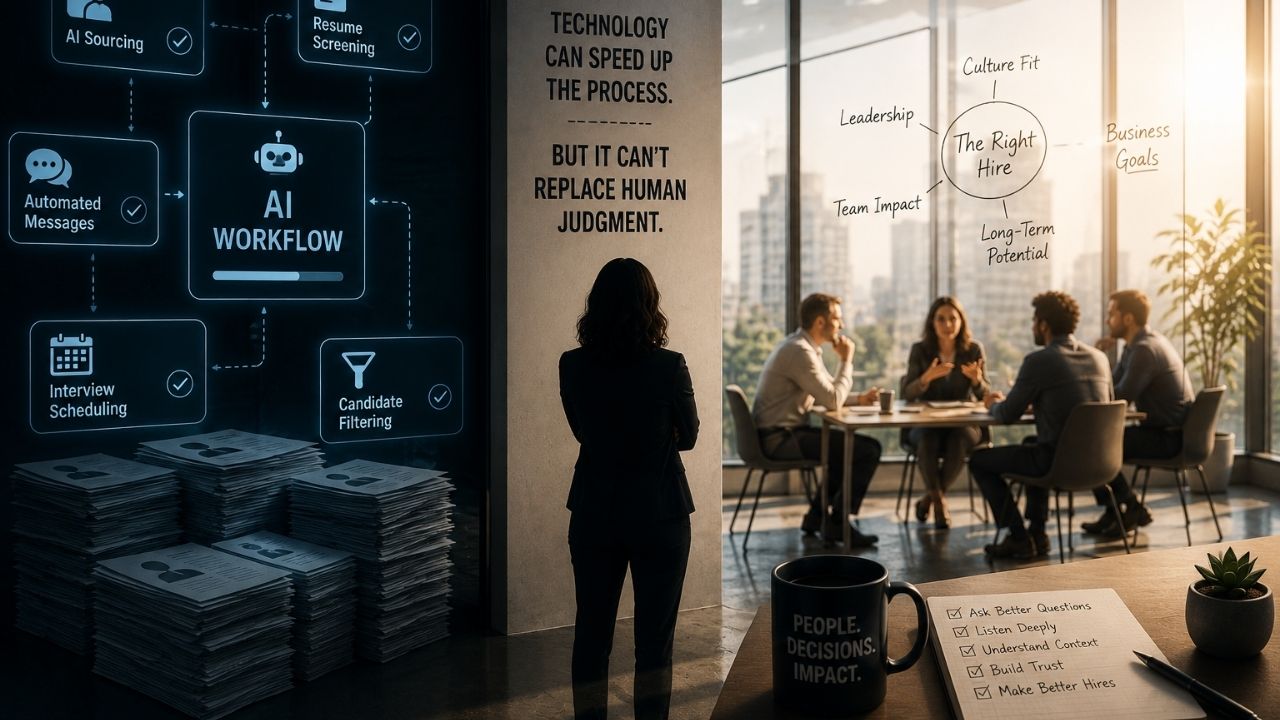
Most AI recruiting conversations focus heavily on speed.
Faster sourcing. Faster screening. Faster scheduling. Faster communication. New tools promise more efficiency across nearly every stage of the hiring process.
At first, the excitement makes sense. Recruiting teams spend enormous amounts of time handling administrative work, repetitive communication, interview coordination, sourcing activity, and candidate filtering. AI can reduce portions of that workload significantly when used correctly.
However, many organizations eventually run into the same operational reality.
Technology can improve recruiting efficiency, but it cannot fix weak hiring discipline. This is where AI conversations often separate from how hiring actually works inside organizations. Companies assume faster workflows automatically create better hiring outcomes. In practice, AI usually amplifies whatever hiring system already exists underneath it.
If the process is strong, AI can improve execution. If the process is unstable, AI often accelerates the instability. That distinction matters more than most organizations realize.
Many of the biggest AI recruiting limitations appear when organizations expect technology to compensate for weak hiring structure and inconsistent decision-making.
AI Improves Administrative Efficiency
AI performs best when solving repetitive operational tasks.
Resume parsing, interview scheduling, candidate outreach drafts, workflow automation, application sorting, and administrative coordination all benefit from efficiency improvements. These tasks consume recruiter bandwidth without always requiring deep strategic judgment.
Used correctly, AI helps recruiting teams recover time for more valuable work. Recruiters spend less energy on repetitive coordination and more time handling candidate conversations, stakeholder alignment, search strategy, and market calibration.
That operational support creates real value. Problems begin when organizations assume efficiency improvements automatically improve hiring quality itself. Speed and hiring discipline are not the same thing, especially during specialized and leadership hiring where alignment, communication, and judgment influence outcomes more than workflow speed alone.
Leadership Misalignment Still Slows Hiring
One of the biggest hiring problems AI cannot solve is leadership disagreement.
Many searches slow down because stakeholders are not aligned on expectations, priorities, compensation, role scope, or decision-making authority before the process even begins.
AI does not fix that.
A faster sourcing system still creates confusion if hiring managers disagree on what they actually want. Automated workflows do not resolve conflicting feedback across stakeholders. AI-generated outreach does not stabilize leadership teams constantly shifting priorities during active searches.
In some organizations, technology actually makes the instability harder to recognize because activity levels increase while alignment problems continue underneath the surface.
This is one reason hiring readiness matters more than recruiting speed during complex searches.
Faster Systems Still Break
Organizations often assume slow hiring automatically means the recruiting process needs more speed.
Sometimes that is true.
However, many hiring systems slow down because the structure behind the process lacks consistency. Decision-making becomes fragmented. Feedback cycles remain unclear. Candidate evaluation standards shift during active searches.
AI does not stabilize those operational problems. In many cases, faster systems simply expose the instability more aggressively because the underlying decision-making issues never changed in the first place.
More candidates enter the process quickly. More interviews get scheduled. More communication workflows activate automatically. However, the same leadership hesitation, unclear expectations, and process instability still exist underneath the activity itself.
A faster broken process is still a broken process.
A similar operational problem appears in Why Recruiting Structure Matters More Than Recruiting Volume.
Scenario: AI Speeds Up an Unstable Process
A company invests heavily in AI recruiting tools during a growth period.
The recruiting team automates sourcing outreach, scheduling coordination, candidate communication, and resume filtering. Pipeline activity increases quickly.
At first, leadership feels encouraged. Recruiters move faster. More candidates enter the funnel. Scheduling delays decrease significantly.
However, operational problems begin appearing almost immediately.
Hiring managers continue disagreeing on candidate fit after interviews. Leadership revisits compensation expectations midway through searches. Feedback remains inconsistent across departments.
As a result, candidates move through the system faster while instability remains unchanged.
Recruiters now spend more time managing recalibration and communication breakdowns because the volume of activity increased without improving alignment underneath the process itself.
The AI tools are functioning correctly.
The hiring system is not.
Recruiter Judgment Still Matters
Strong recruiting still depends heavily on human judgment.
Experienced recruiters constantly evaluate timing, communication risk, leadership alignment, candidate motivation, compensation flexibility, and process confidence throughout a search. Those variables shift continuously during active hiring processes.
AI can assist portions of that work, but it cannot fully replace the situational judgment recruiters use to manage complexity during high-stakes hiring decisions.
This becomes especially important during leadership and specialized searches where nuance matters far more than administrative speed alone.
Organizations sometimes underestimate how much recruiting success depends on interpretation, timing, and relationship management instead of automation. That misunderstanding creates unrealistic expectations around what AI can realistically improve.
Candidates Still Evaluate the Process
Candidates evaluate hiring processes constantly.
They pay attention to communication quality, responsiveness, transparency, leadership consistency, and organizational professionalism throughout the experience. AI can support portions of that communication process, but over-automation often weakens trust when interactions begin feeling disconnected from reality.
Generic outreach, templated updates, and automated follow-ups create friction when candidates expect clarity and human interaction during important moments.
This risk becomes even larger during senior-level searches where candidates already evaluate organizational maturity throughout the process itself.
Strong hiring processes still require strong communication.
We discussed a related communication problem in The Risk of Over-Automating Candidate Communication.
AI Recruiting Limitations Become Visible Quickly
One of the most important operational realities around AI recruiting is that technology usually exposes existing hiring weaknesses faster.
Organizations with poor feedback discipline, unclear role definitions, inconsistent evaluation standards, weak stakeholder alignment, unstable communication, or reactive hiring behavior often struggle more after introducing AI because the process now moves faster than the organization can manage effectively.
At first, increased activity creates the appearance of improvement.
Over time, however, the same operational problems continue slowing decisions, weakening candidate confidence, and creating instability throughout the search.
AI did not create the problem.
It accelerated visibility into a problem that already existed.
Scenario: Automated Outreach Creates Skepticism
A recruiting team begins using AI-generated outreach messages at scale.
Initially, response rates increase because outreach volume expands dramatically. Recruiters contact significantly more candidates across multiple searches simultaneously.
However, candidates begin recognizing patterns quickly.
Messages sound generic. Technical details feel inaccurate. Outreach references experience that does not actually align with the candidate’s background.
At first, recruiters dismiss the concern because activity metrics still appear strong.
Over time, response quality declines. Candidates disengage earlier. Conversations become shorter and less trusting because the communication feels transactional instead of intentional.
The issue is not AI itself.
The issue is using automation without enough recruiter oversight or communication discipline.
A similar operational strain appears in Why Hiring Delays Create Operational Debt.
Operational Discipline Determines AI Value
Organizations receiving the most value from AI recruiting tools usually had strong hiring discipline before the technology arrived.
Their hiring processes already included clear expectations, aligned stakeholders, structured communication, defined evaluation standards, operational accountability, and consistent decision-making.
AI improves those systems because the operational foundation already exists.
The technology supports execution instead of compensating for instability.
Organizations with weak hiring discipline often expect AI to create operational structure automatically. That rarely happens.
Technology can support a strong hiring process. It cannot create one from scratch.
Efficiency and Hiring Quality Are Different
Recruiting efficiency measures activity flow.
Hiring quality measures decision quality.
Organizations sometimes confuse the two because both appear connected operationally. Faster workflows create the impression of stronger hiring performance.
However, efficient activity can still produce weak hiring outcomes if role expectations remain unclear, stakeholders remain misaligned, communication weakens, candidate trust declines, or decision-making stays unstable.
AI improves portions of recruiting efficiency extremely well. Hiring quality still depends heavily on leadership discipline, communication, process consistency, and organizational alignment.
Those are operational behaviors, not software features.
This issue also shows up in When Hiring Feels Busy but Nothing Moves Forward.
The Market Is Already Adjusting
Candidates are already adapting to AI-driven recruiting behavior.
Experienced professionals recognize generic outreach quickly. Automated communication patterns feel increasingly obvious. Candidates notice when conversations lack context or personalization.
Recruiting teams now face a different communication problem.
As automation becomes more common, authentic communication becomes more valuable.
Organizations that balance technology with strong recruiter judgment and operational discipline will likely maintain stronger candidate trust over time. Organizations that over-automate every interaction risk weakening credibility during the exact moments where confidence matters most.
Where AI Actually Helps
AI creates the most value when it supports operational consistency without replacing human judgment entirely.
The strongest use cases usually involve administrative automation, scheduling coordination, sourcing assistance, workflow visibility, communication support, and repetitive task reduction. These improvements matter because they allow recruiters to spend more time on the parts of hiring that technology still struggles to handle well.
The goal should not be removing humans from recruiting.
The goal should be allowing recruiters to spend more time on the parts of hiring that actually require human judgment.
Why Hiring Discipline Still Matters
AI can improve recruiting efficiency significantly.
It cannot replace hiring discipline.
Technology helps organizations move faster, communicate more consistently, and reduce administrative workload across the hiring process. However, AI does not resolve leadership disagreement, unstable decision-making, unclear expectations, weak communication, or poor hiring structure.
Those problems still require operational alignment and human judgment.
The most important AI recruiting limitations usually have nothing to do with software performance and everything to do with operational discipline inside the hiring process.
Organizations receiving the most value from AI recruiting tools usually already had disciplined hiring systems before the technology arrived. The companies struggling most with AI recruiting often expect technology to compensate for organizational instability the process already contained.
AI can improve parts of recruiting operations significantly. Leadership discipline, communication quality, and decision-making still determine whether the hiring process actually works.
Related Articles
The Risk of Over-Automating Candidate Communication
Why Recruiting Structure Matters More Than Recruiting Volume
How to Build a Hiring Process That Works for Senior and Specialized Roles
Why Hiring Delays Create Operational Debt
When Hiring Feels Busy but Nothing Moves Forward
Hiring Readiness Is More Important Than Hiring Urgency