
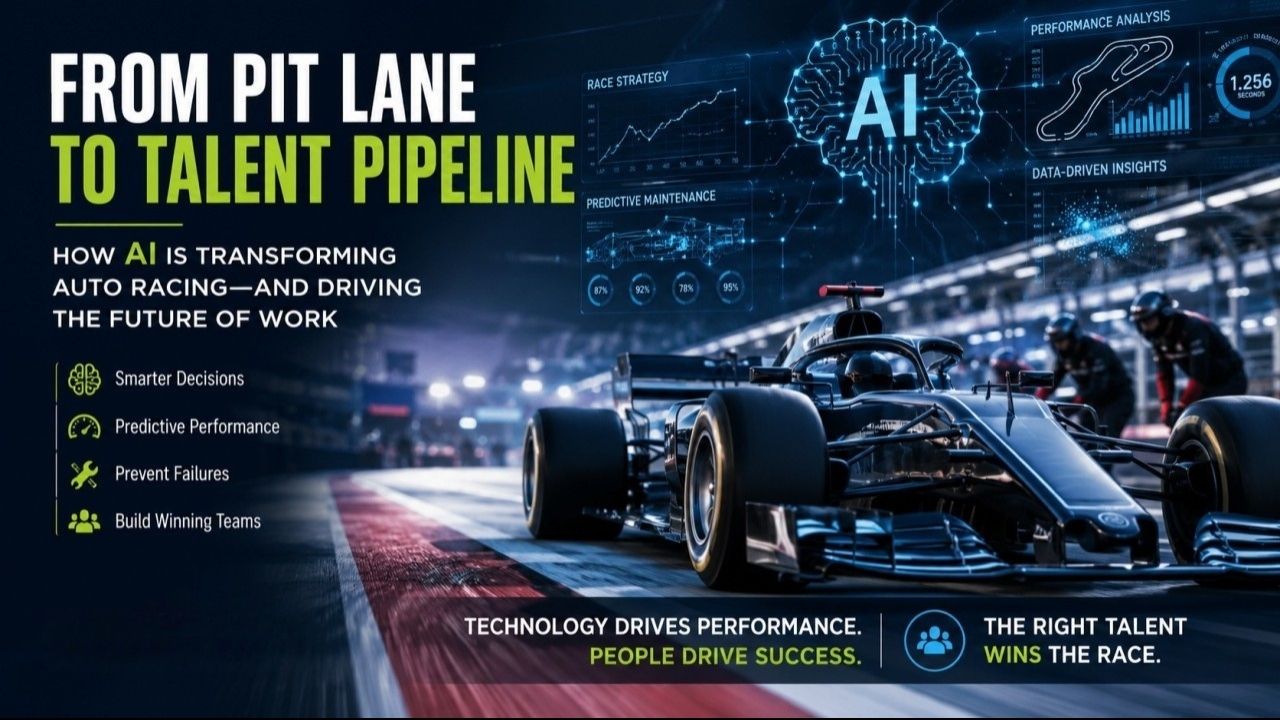
From Pit Lane to Talent Pipeline
Written by:
Ivan Jackson
For as long as I can remember, I’ve been fascinated by motorsports. Whether it’s Formula 1, endurance racing at Le Mans, IndyCar, NASCAR, or sports car racing, the combination of human skill, engineering excellence, and strategic decision-making has always captivated me.
Today, however, a new competitor is entering the race.
Artificial Intelligence.
While AI has become one of the most discussed topics in business, its impact on auto racing offers a fascinating glimpse into how organizations across every industry can use technology to gain a competitive edge. In many ways, modern racing teams have become real-world laboratories for AI adoption, and the lessons extend far beyond the racetrack.
How AI Talent Acquisition Starts on the Racetrack
Modern race cars generate enormous amounts of data.
A Formula 1 car can produce more than a million data points during a race weekend. Sensors monitor everything from tire temperatures and brake wear to fuel consumption, suspension movement, aerodynamic efficiency, and driver inputs.
Historically, teams relied on engineers and analysts to process this information. Today, AI systems can analyze those data streams in real time, identifying patterns and opportunities that humans might miss.
The result?
Faster decisions, better performance, and a significant competitive advantage.
Sound familiar?
It’s the same reason businesses are embracing AI today.
AI Is Changing Race Strategy
One of the most visible uses of AI in motorsports is race strategy.
Teams must constantly make decisions regarding:
- Tire selection
- Pit stop timing
- Fuel management
- Weather response
- Driver pace management
- Competitor positioning
An AI model can process thousands of potential race scenarios in seconds, helping strategists determine the optimal course of action.
Rather than relying solely on historical data or intuition, teams can now simulate countless possibilities and adjust in real time as conditions change.
For business leaders, this mirrors how AI is helping organizations improve forecasting, resource allocation, and operational planning.
Predictive Maintenance Is Reducing Failures
Few things are more devastating in racing than a mechanical failure.
A championship can be won or lost because of a single broken component.
To combat this risk, teams increasingly use AI-powered predictive maintenance systems. These systems analyze sensor data and identify early warning signs before a failure occurs.
Rather than replacing parts on a fixed schedule, teams can make informed decisions based on actual performance and wear patterns.
Manufacturers, airlines, logistics companies, and industrial organizations are now applying the same concepts to reduce downtime and improve reliability.
Driver Performance Analysis Has Reached a New Level
Elite drivers constantly search for fractions of a second.
AI tools now help teams analyze:
- Braking points
- Steering inputs
- Throttle application
- Cornering techniques
- Racecraft decisions
By comparing thousands of laps, AI can identify opportunities for improvement that may not be visible through traditional video review.
The technology isn’t replacing drivers.
It’s helping them become better.
That’s an important distinction that extends well beyond motorsports. The most successful AI implementations don’t replace human expertise. They augment it.
The Talent Race Has Started
Perhaps the most interesting impact of AI on motorsports isn’t happening inside the car.
It’s happening inside the garage.
Racing organizations are increasingly hiring professionals with expertise in:
- Artificial Intelligence
- Machine Learning
- Data Science
- Software Engineering
- Cloud Infrastructure
- Cybersecurity
- Simulation Technologies
The modern race team increasingly resembles a technology company.
In fact, many Formula 1 teams now employ hundreds of software engineers, analysts, and data scientists who may never touch a race car but directly influence performance on race day.
This trend reflects what we’re seeing across nearly every industry. Companies that once competed primarily through products or services are now competing through data, analytics, and technology talent. If that ceiling sounds familiar, it’s worth reading Most Companies Have a Recruiting Ceiling, And Don’t Realize It.
What This Means for Employers
The AI revolution isn’t coming.
It’s already here.
Organizations across healthcare, manufacturing, financial services, retail, technology, and transportation are all competing for many of the same skilled professionals.
The challenge is that demand is growing faster than supply.
Companies that wait too long to build AI capabilities risk finding themselves in the same position as a racing team trying to compete with outdated equipment.
The organizations gaining an advantage today are investing in talent, upskilling existing employees, and partnering with recruiting firms that understand the evolving market.
Final Lap
Motorsports have always been a proving ground for innovation.
Disc brakes, carbon fiber construction, aerodynamic advancements, and hybrid technologies all found their way from the racetrack into everyday vehicles.
Artificial Intelligence is following a similar path.
What begins as a competitive advantage for elite racing teams quickly becomes a business necessity for organizations everywhere.
The winners won’t be determined solely by technology.
They’ll be determined by the people who know how to build, deploy, and use it effectively.
Just like racing, success ultimately comes down to putting the right team together.
And that’s a race every organization is running today. For a broader look at what this shift means for hiring, Recruiting Reimagined. And Why Right Now It Has Never Mattered More. is a good place to start.
RELATED ARTICLES
Most Companies Have a Recruiting Ceiling, And Don’t Realize It
Recruiting Reimagined. And Why Right Now It Has Never Mattered More.