
Watch CFO Behavior Before You Watch CFO Exits
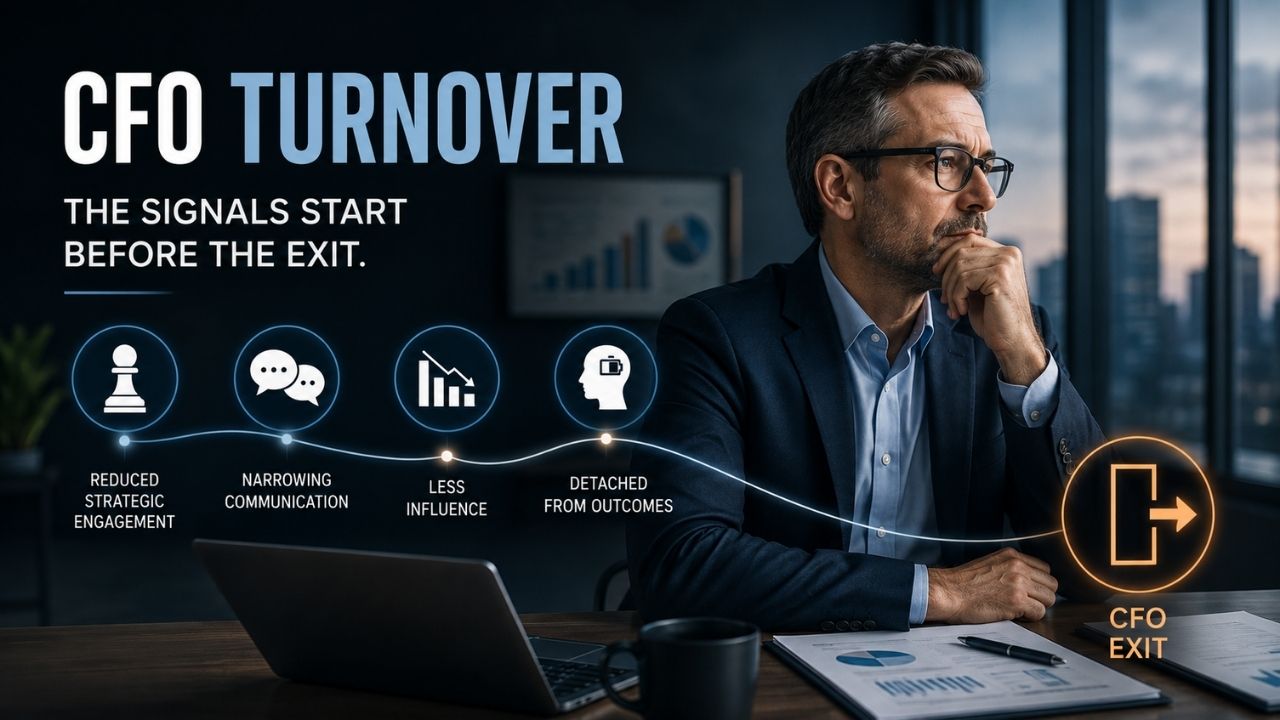
Most CFO turnover does not start with a resignation.
It starts with a behavioral shift.
Long before a CFO formally disengages, the signals are usually there. They’re just subtle enough that organizations tend to miss them until much later.
At their best, strong CFOs operate beyond finance.
They shape decisions. Push accountability. Drive planning. Pressure-test assumptions. Connect operations to outcomes.
You can feel their presence in the business.
Which is why the earliest warning signs are often behavioral, not performance-related.
The Shift Usually Starts Quietly
What I see most often is not a sudden breakdown.
It’s gradual detachment.
The CFO who once leaned into long-range planning starts focusing only on near-term execution.
Cross-functional engagement narrows.
Forward-looking conversations become more cautious, more transactional.
The appetite to challenge weak assumptions starts to fade.
This is rarely about effort.
In many cases, the CFO is still performing at a high level.
But something has changed underneath the surface.
Usually one of three things is happening:
- the scope of the role has evolved without acknowledgment
- the operating environment has become unsustainably reactive
- or the CFO no longer believes the organization is addressing the real issues
This kind of executive disengagement tends to emerge long before formal turnover conversations begin, especially when leadership expectations evolve faster than the organization around them, which connects closely to The Year-5 CEO Problem: When the Mandate Changes.
Why PE-Backed CFO Roles Become More Complex Over Time
In PE-backed businesses, this dynamic has become more common as hold periods extend.
The job the CFO signed up for in years 1–3 often looks very different by years 5–7.
What began as a growth and transformation mandate can slowly shift into:
• operational triage
• governance strain
• reporting compression
• resource imbalance
• or prolonged uncertainty around timing and direction
The title stays the same.
The job does not.
This is where many organizations underestimate how dramatically executive operating conditions can shift during extended growth cycles, which is something we explored further in Executive Decision-Making: How to Hire Leaders Who Simplify Complexity.
When CFOs Get Pulled Too Far Downward
One of the more overlooked pressure points is what happens beneath the CFO.
When FP&A, controllership, and finance operations are underbuilt, the CFO gets pulled downward into the organization.
Instead of driving forward, they start compensating.
That works temporarily.
Over time, even strong CFOs begin operating in survival mode rather than leadership mode.
This operational compression becomes especially dangerous when organizations rely too heavily on executive compensation for structural gaps elsewhere in the business, which connects closely to Hiring Is an Operational Decision: Where Hiring Decisions Break Down—and How Strong Leaders Fix Them.
The Signals Usually Appear Before the Exit
The mistake many organizations make is waiting for a visible performance issue before recognizing the problem.
By then, the disengagement has usually been building for a while.
The earlier indicators are quieter:
• reduced strategic engagement
• narrowing communication
• less organizational influence
• emotional detachment from long-term outcomes
Most CFOs do not announce they are burning out, frustrated, or losing confidence in the trajectory.
Their behavior tells you first.
The strongest leadership teams recognize these signals early, not as reasons to panic, but as indicators that something in the system may no longer be aligned.
Because in many cases, the issue is not the CFO.
It is the environment surrounding the CFO role.
Related Articles
The Year-5 CEO Problem: When the Mandate Changes
Executive Decision-Making: How to Hire Leaders Who Simplify Complexity
Hiring Is an Operational Decision: Where Hiring Decisions Break Down—and How Strong Leaders Fix Them