
CFO or Controller? It’s Not the Choice… It’s the Order
Most growing companies hire the wrong financial seat first. Here’s why a Controller is the move… and what that actually gets you.
There’s a pattern I see in companies between $10M and $50M in revenue. Growth is happening. The business is moving. But the financial picture? Not as clear. Numbers exist… but nobody fully trusts them. So the founder or CEO decides it’s time to bring in financial leadership.
And the instinct is almost always the same: Hire a CFO.
I get it. CFO sounds right. It feels like the answer to the fog. But in most of these situations… it isn’t the right first hire. And making it anyway costs companies time, money… and sometimes the credibility of the function itself.
The Foundation Has to Come First
Before any organization can benefit from financial strategy… it needs financial truth. Clean books. A reliable close process. A chart of accounts that actually reflects how the business operates. Systems that talk to each other. Reporting that doesn’t take hours of manual work to produce.
Most companies at this stage don’t have that. They have accounting built around tax season and survival… not decision-making. That’s not a criticism. It’s how early-stage companies make it through.
A Controller fixes that. A CFO assumes it already exists.
When that foundation isn’t clear, even strong finance candidates struggle to step into the role effectively. It’s a common reason processes stall and expectations misfire, especially in growth-stage companies, as outlined in Why Finance Candidates Walk Over Role Ambiguity.
What a Controller Actually Does
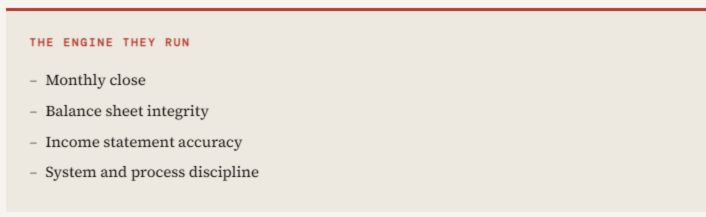
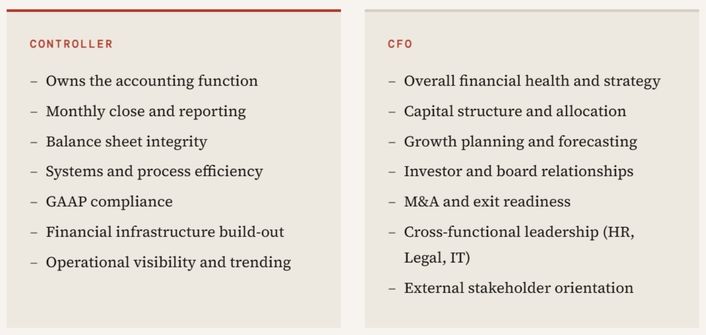
The Controller is the quarterback of your accounting operation. They own the day-to-day financial engine: the monthly close, the balance sheet, the income statement, the integrity of your numbers. They’re asking where the revenue is coming from, what the trends mean, where the inefficiencies are hiding, and whether your systems are actually supporting the business or just keeping up with it.
A strong Controller will come in, assess what you’ve built, clean it up, and build a financial infrastructure that scales. They’ll modernize your accounting process, tighten your close cycle, and give you a real-time view of the organization’s financial health, not a rearview mirror.
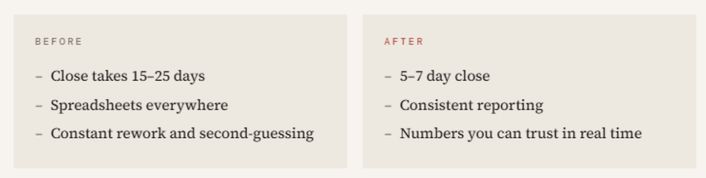
That visibility changes how you run the business. You stop making decisions by feel. You start making them by fact.
For companies trying to get this right, clarity around the role and expectations makes all the difference, which is why Hiring Controllers and Senior Analysts Without Guesswork is such a critical starting point.
What a CFO Actually Does
A CFO operates at a different altitude. They’re thinking about the financial health of the organization as a whole, not just the accounting function. Capital allocation. Growth strategy. How the company is positioned in the market. What the numbers today mean for where the company is going.
A true CFO often oversees more than finance. HR, legal, IT, risk, sometimes operations. In many growth-stage companies, the CFO and COO functions overlap because the person running finance has the deepest understanding of how the entire business functions, including the teams that face the market.
That’s a significant scope. And it requires a solid financial foundation underneath it to be effective.
The Football Analogy Holds Up
If the Controller is the quarterback, the CFO is the head coach. The coach sets the strategy, reads the field, and makes the calls that win games. But none of that works if the quarterback doesn’t have clean routes to run, a solid line in front of them, and an offense that executes.
You don’t start by hiring a head coach. You build the team first.
That’s what a Controller does for your finance function.
When CFO Actually Makes Sense
There’s a point where the Controller has done the work, the foundation is clean, and the company needs someone thinking two or three moves ahead. Capital raise. Acquisition. Geographic expansion. A liquidity event on the horizon.
That’s when the CFO conversation changes. Now they have something to work with. Now the strategic layer actually has traction.
Hiring a CFO before that point doesn’t just cost you the wrong salary. It means the person you hired is either doing Controller work, which is not what they want to be doing, or they’re building strategy on a foundation that isn’t ready to support it.
Neither outcome serves you.
This is also where many finance searches start to stall. Expectations don’t match reality, and alignment breaks down late in the process, which is exactly what we see in Why Finance Searches Stall Late in the Process.
The Practical Call
If you’re running a growing company, doing $10M to $75M in revenue, and you’re thinking about your first real accounting hire, start with a Controller. Find someone who has cleaned up a messy financial operation before, who understands how accounting connects to operations, and who can build the infrastructure your next stage of growth actually requires.
Get your financial house in order. Understand your numbers at a level that drives decisions. Build the foundation.
The CFO conversation will come. When it does, you’ll be ready for it.
Not every company is here yet. But if you’re in that $10M–$75M range and this hit… you’re probably closer than you think.
Related Articles
Why Finance Candidates Walk Over Role Ambiguity
Hiring Controllers and Senior Analysts Without Guesswork
Why Finance Searches Stall Late in the Process