
The Hiring Surge Trap — And the Smarter Way Out
Written by Michelle Carlberg
It happens more often than most leaders want to admit.
A new project launches. A facility opens. A market expands. And suddenly, the organization is starting down 20, 30, or 50 open roles that need to be filled, fast.
The instinct? Hire another internal recruiter.
It feels logical. It feels like control. It feels like the responsible thing to do.
But in many cases, it is one of the most expensive reactive decisions an organization can make.
The Real Cost of Adding a Recruiter You Don’t Need Long-Term
Let’s start with the numbers most organizations gloss over when the pressure to hire gets high.
The average salary for a talent acquisition specialist runs $60,000–$80,000 per year, before benefits. But that is only the beginning.
Benefits typically add another 25–40% on top of base salary. That means a $70,000 internal recruiter is actually closer to $87,500–$98,000 in total annual cost… before you factor in a single tool, license, or piece of technology they need to do the job.
Then add:
- LinkedIn Recruiter licenses
- Applicant tracking software
- Job board subscriptions
- Onboarding time
- Management overhead
- Ramp-up period before they are fully productive
Research indicates that internal HR recruiters can inflate hiring costs by 50% or more, with an internal recruiter earning $51,000 adding at least $4,250 per month in additional hiring costs, without factoring in the add-ons.
Now multiply that across a 4–6 month hiring surge.
You are not just paying for recruitment. You are paying for an entire infrastructure commitment…attached to a temporary need.
This is often where embedded or managed recruiting support becomes more effective, allowing organizations to scale hiring capacity without committing to permanent internal headcount.
And Then the Project Ends…
This is where it gets uncomfortable.
The build-out is complete. The expansion is done. The new facility is staffed.
Now what?
You have an internal recruiter, with a full salary, benefits, and overhead…sitting inside an organization that no longer has 30 open roles to fill.
Three options land on the table. None of them are easy.
Option 1: Keep them. Absorb the cost even when hiring volume drops. Hope they find enough to stay productive. Watch leadership quietly question the budget line.
Option 2: Reassign them. Try to plug them into HR tasks or projects they were not hired to do. Create frustration on both sides.
Option 3: Let them go. Pay severance. Navigate the morale impact. Start the cycle again next time demand spikes.
This is the hiring surge trap, and it plays out in organizations of every size, across every industry.
The Numbers Behind the Problem
The financial exposure here is significant and often underestimated.
Over a typical 42-day hiring period, the average vacancy costs employers approximately $4,129, equating to being over $98 per day in lost productivity, on top of recruitment expenses.
The total fully loaded cost of an employee typically reaches 1.25 to 1.5 times base salary or more once all mandatory expenses are factored in.
And when hiring is mishandled or rushed under pressure, the downstream cost can be even larger. A poor hiring decision can ultimately cost a company up to 300% of the employee’s salary.
The pressure is real. The stakes are real. But the solution does not have to be a long-term payroll commitment.
In many cases, organizations find that flexible recruiting capacity provides a more practical path than expanding internal teams during short-term hiring spikes.
There Is a Smarter Way to Scale
This is exactly the conversation more organizations need to have before the surge hits, not in the middle of it.
Two flexible models are proving to be far more effective for temporary hiring spikes:
Contract Recruiters
A contract recruiter embeds directly into your team, operating as an extension of your internal hiring function without becoming a permanent addition to your payroll. They bring industry knowledge, sourcing capability, and process discipline. When the project ends, so does the engagement.
No severance. No long-term overhead. No awkward reassignment conversations, and so much more.
RPO — Recruitment Process Outsourcing
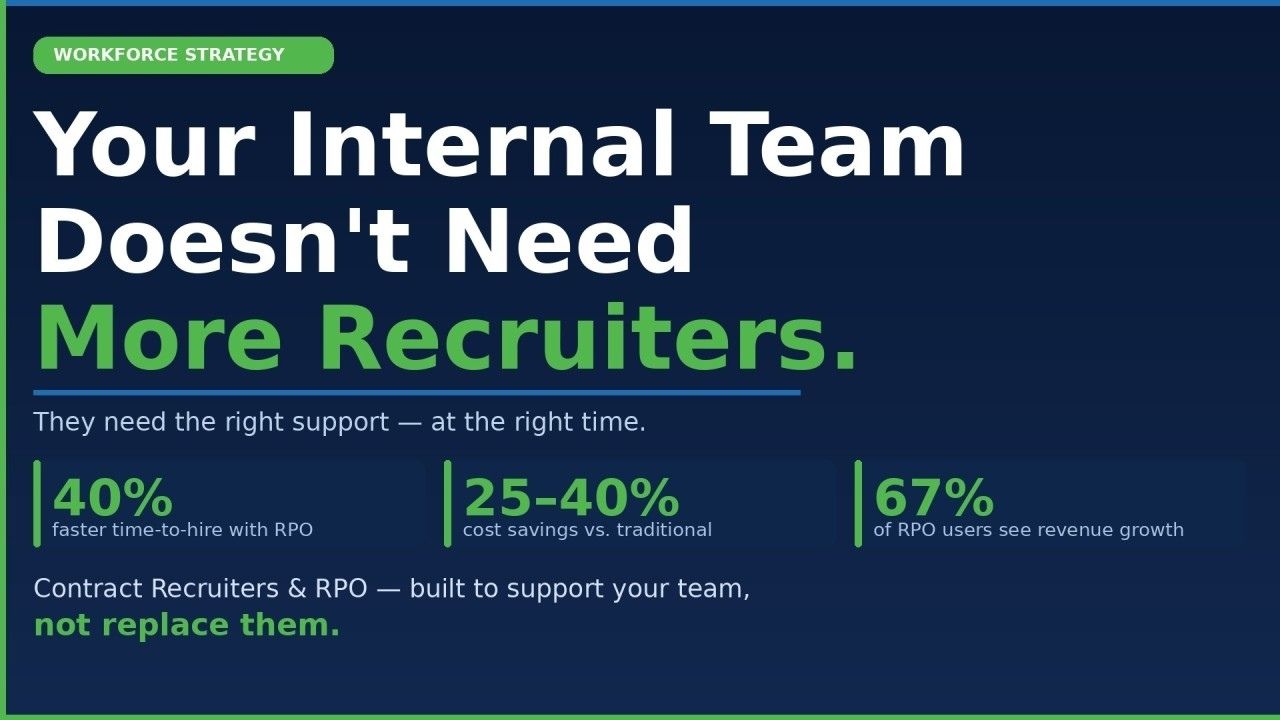
For larger hiring initiatives, an RPO model provides an entire recruiting infrastructure on a project or scalable basis. Organizations typically experience project RPO cost savings of 25–40% compared to traditional hiring methods.
The results speak for themselves:
- Companies using RPO report up to 40% faster time-to-hire compared to in-house recruiting only.
- 60% of organizations working with RPO partners note higher quality-of-hire due to better screening and evaluation rigor.
- 67% of companies using RPO experienced revenue growth, compared to only 33% of non-RPO users.
- HROA studies show RPO can result in cost savings of up to 40% by reducing time-to-fill, improving the quality of hires, and lowering attrition rates.
The global RPO market is growing at a 17.5% annual rate for a reason: organizations are looking for more predictable, efficient recruiting systems that do not require permanently expanding internal headcount.
This Is Not About Replacing Your Internal Team
It is important to say clearly: this is not an argument against internal recruiting teams.
Internal recruiters are essential to long-term talent strategy, employer brand, and cultural continuity. They own what they should own.
The question is whether it makes organizational and financial sense to permanently expand that team every time a temporary surge arrives.
In most cases, it does not.
A new facility opening, a large project ramp-up, relocating to a new market, or a short-term volume spike are all situations where flexible recruiting capacity, not permanent headcount, is the right answer.
Scale up. Hire well. Scale down.
Protect your capital. Protect your team. Protect your momentum.
A Simple Question Worth Asking Before the Next Surge
Before you post that internal recruiter job description, pause and ask:
- How long will this hiring demand actually last?
- What happens to this role when the volume drops?
- Is there a more flexible, cost-effective way to solve this problem?
In most surge scenarios, the answer already exists.
It just does not always look like another permanent hire.
As a talent and workforce strategy partner, I help organizations in manufacturing, construction, and operations build smarter, more flexible hiring systems.
Related Articles
Why Mid-Market Companies Shift to Managed Solutions
When Embedded Recruiting Makes Sense
The Difference Between Recruiting Support and Ownership