
LinkedIn Just Changed the Rules for Job Seekers. Nobody Told the Hiring Leaders.

This morning, LinkedIn’s Editor-in-Chief went on the Today Show to explain how AI has rewritten the game for job candidates. He’s right. But he only told half the story.
The Half That Wasn’t Said
Dan Roth was recently on the Today Show discussing how AI is changing the job search process, how it has changed what it means to apply, to be seen, and to stand out. If you’re a job seeker, that’s genuinely valuable advice.
But if you’re the one doing the hiring? The one running a division, trying to fill a critical operations role, or sitting in a leadership meeting where the same open position has been on the agenda for three months?
Here’s what nobody said.
The rules changed for you too. And most organizations haven’t noticed yet.
When candidates learn to game your process faster than you learn to update it, you don’t have a talent shortage. You have a signal problem.
What the New Rules Mean for Hiring Leaders
Here’s the uncomfortable reality.
The same AI tools helping candidates look more polished, more keyword-optimized, and more qualified on paper are also flooding your pipeline with people who have learned to speak your screening system’s language.
That’s not the candidates’ fault. That’s a rational response to the environment LinkedIn, career coaches, and job search experts are encouraging them to navigate.
The problem is what it does to you.
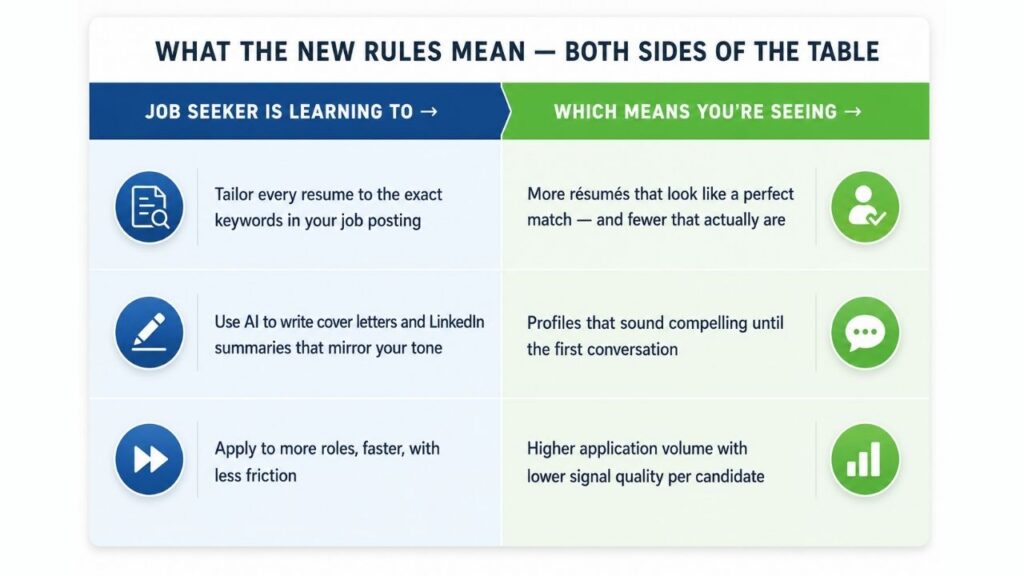
Your screening tools were built for a different era. Job descriptions written from memory. A process designed for a market where applicants spent real effort before applying.
That market is gone.
The gap between automation and human evaluation is becoming increasingly important, which is something we explored further in The Human Parts of Hiring AI Still Cannot Replace.
Three Things Worth Rethinking Right Now
Your Job Description Is No Longer a Filter
Your job description has become a keyword guide.
Candidates are being coached to mirror it back to you almost verbatim. If your JD is vague, generic, or copied from the last hire, you’ll attract everyone and identify no one.
The organizations winning right now are writing for operational specificity, not HR compliance.
Your ATS May Be Screening Out Your Best Candidates
The most experienced operators in manufacturing, construction, and skilled trades, the people who built careers through field execution rather than LinkedIn optimization, are often being filtered out before a human ever sees them.
They don’t have keyword-rich profiles.
They have results.
Those are not the same thing.
The Candidate Who Performs Best May Not Be the Best Hire
AI coaching is becoming very good at helping people perform well in structured interviews, write polished follow-up emails, and present confidence on paper.
None of that tells you whether someone can run your floor, own a P&L, or hold a team together under pressure.
You need different questions.
You may need different conversations entirely.
Long-term hiring success depends on identifying the right person for the role rather than the person who performs best in the process, which connects closely to What Success in Hiring Actually Looks Like.
The Real Opportunity
Dan Roth is right that the job search has changed dramatically.
LinkedIn is right that AI is reshaping how people find and land work.
But here’s what I’d add from three decades of watching how talent actually moves through organizations.
The leaders who thrive in this environment won’t be the ones who adopted the latest AI screening tools.
They’ll be the ones who got sharper about what human judgment is actually for and stopped outsourcing it to a process that was already struggling to identify the right people.
Organizations are increasingly being forced to rethink how hiring works from the ground up, which is something we discussed in Recruiting Reimagined. And Why Right Now It Has Never Mattered More.
A Conversation Worth Having
I’d like to hear what you’re actually seeing.
If you’re leading a team right now, what has changed in your hiring process during the last 12 months?
Are you getting more applicants but less certainty?
Are the right people harder to identify, or simply harder to find?
Drop a comment or send me a message.
I’m not interested in giving you a sales pitch.
I’m interested in understanding what the market looks like from the other side of the desk because that’s where the real conversation starts.
And if what I described above feels uncomfortably familiar, that’s not a coincidence.
It’s why recruitAbility exists.
Related Articles
The Human Parts of Hiring AI Still Cannot Replace
What Success in Hiring Actually Looks Like
Recruiting Reimagined. And Why Right Now It Has Never Mattered More.