
The Leadership Behaviors That Quietly Break Hiring
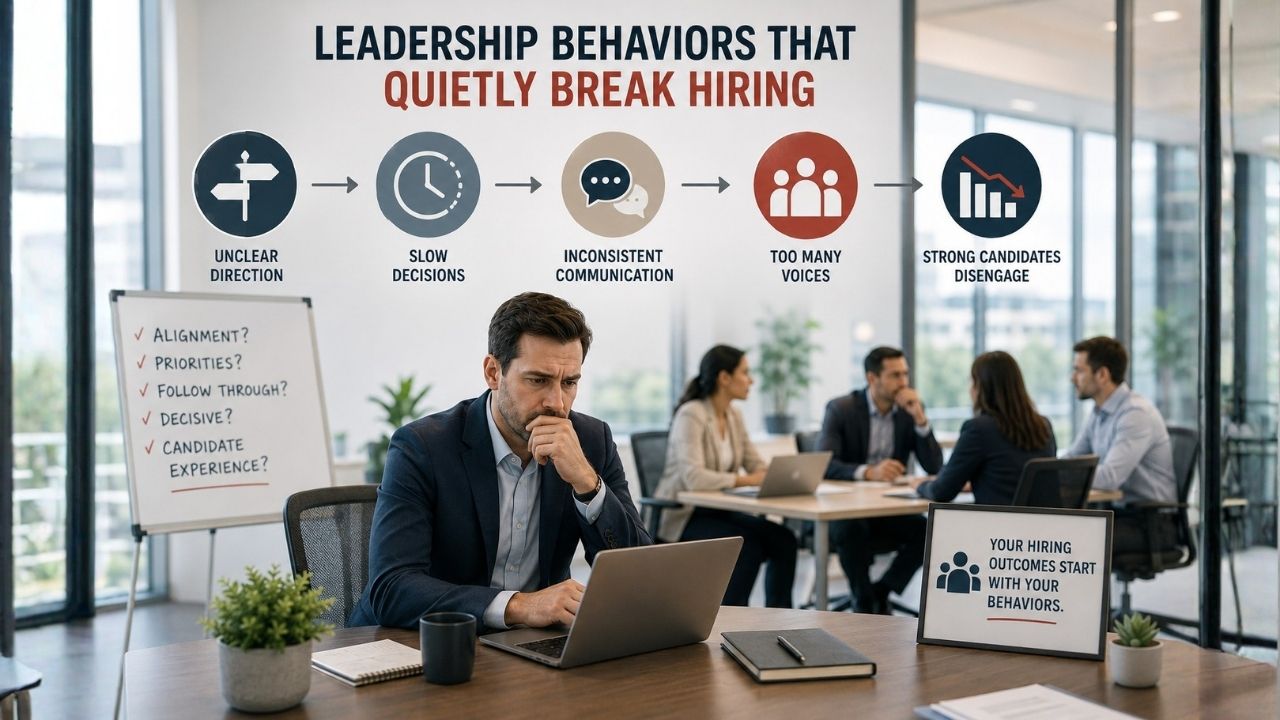
Most organizations blame hiring problems on external factors first.
The market is too competitive. Candidates expect too much compensation. Recruiting teams cannot move fast enough. Skilled talent is harder to find. Too many companies are competing for the same people.
Sometimes those challenges are real.
Many hiring problems, however, start internally long before sourcing becomes the issue.
Leadership behavior shapes hiring outcomes far more than most organizations are willing to acknowledge.
Not through obvious dysfunction.
More often, hiring processes break through smaller leadership behaviors that slowly create instability across decision-making, alignment, communication, and execution throughout the organization.
That is what makes these problems difficult to recognize early.
The process may still appear functional on the surface. Interviews continue happening. Candidates remain in the pipeline. Meetings continue getting scheduled. Internally, however, friction keeps building underneath the process itself.
Eventually, hiring quality starts deteriorating.
Strong candidates disengage. Timelines stretch longer. Stakeholder alignment weakens. Decision confidence drops. Internal frustration rises. Recruiting teams become reactive because leadership behavior itself keeps destabilizing the process operationally.
Most organizations do not recognize these patterns as leadership issues because the behaviors often appear reasonable in isolation.
Collectively, however, they create significant hiring risk.
Leadership Indecision Creates Organizational Instability
One of the most damaging leadership behaviors in hiring environments is prolonged indecision.
This does not always look dramatic operationally.
More often, leadership indecision appears through extended evaluation cycles, repeated reconsideration of priorities, delayed feedback, or constant requests for additional comparison points before moving forward.
Internally, these behaviors often feel responsible.
Leaders believe they are being thoughtful, cautious, or thorough.
Candidates experience something very different.
The process begins feeling unstable.
Strong candidates notice when organizations repeatedly revisit decisions without creating additional clarity. They recognize when leadership teams appear uncomfortable committing to direction. They notice when confidence inside the process feels inconsistent from one conversation to the next.
Over time, hesitation changes candidate behavior significantly.
Enthusiasm weakens. Trust erodes. Emotional investment declines. Alternative opportunities begin receiving more attention.
Meanwhile, the organization often believes the process is still progressing normally because interviews continue happening operationally.
In reality, confidence may already be deteriorating underneath the surface.
As explored further in Why Strong Candidates Disengage Before You Notice, disengagement usually develops gradually long before organizations recognize the warning signs.
Changing Expectations Mid-Process Creates Friction
Another leadership behavior that quietly damages hiring outcomes is shifting expectations throughout the process itself.
This becomes especially common in growing organizations operating under pressure.
The role starts changing mid-search. Priorities evolve. Leadership teams begin reconsidering experience requirements, reporting structures, or execution expectations after candidates have already entered the pipeline.
Sometimes these adjustments are necessary.
Frequently, however, the changes reflect internal uncertainty rather than actual business evolution.
That distinction matters significantly.
Candidates notice when expectations continue moving. Recruiters struggle maintaining alignment because evaluation standards no longer remain stable. Stakeholders start assessing candidates against different versions of the role itself.
Eventually, the process becomes increasingly difficult to stabilize because the organization is no longer evaluating talent against a consistent definition of success.
This creates downstream execution problems quickly.
Feedback quality weakens. Interview consistency disappears. Candidate confidence declines. Decision-making slows because stakeholders are no longer operating from shared expectations internally.
Many organizations assume these adjustments are minor operationally.
Strong candidates rarely experience them that way.
Overinvolvement Weakens Decision Quality
Leadership teams often assume greater involvement automatically improves hiring outcomes.
That is not always true.
As organizations grow, executives frequently insert themselves deeper into hiring processes in an attempt to reduce risk, improve visibility, or strengthen evaluation quality.
Sometimes this adds value.
In many cases, however, excessive leadership involvement creates operational drag instead.
Additional stakeholders expand scheduling complexity. Interview structures become heavier. Decision ownership becomes less clear. Feedback loops grow longer because too many perspectives now require alignment before the process can move forward.
The organization gradually becomes slower, heavier, and less decisive operationally.
This is one reason leadership behavior often contributes directly to hiring friction without executives fully recognizing the impact.
The issue is rarely effort.
More often, the issue becomes process gravity created by expanding layers of oversight, evaluation, and internal consensus management.
Organizations frequently mistake heavier processes for lower-risk processes.
In reality, expanded interview structures often increase friction while weakening organizational decisiveness. This challenge is explored further in Why “More Interviews” Does Not Reduce Risk.
Delayed Feedback Signals Priority Problems
Most leaders do not intentionally create hiring delays.
Operationally, however, delayed feedback almost always communicates something important internally and externally.
When feedback consistently stretches too long, candidates start questioning organizational alignment, urgency, and operational discipline. Recruiting teams struggle maintaining momentum because timelines become unpredictable. Stakeholders lose clarity because conversations drift further apart operationally.
Internally, leadership teams often rationalize these delays because other priorities feel more urgent in the moment.
That response creates a dangerous pattern over time.
Hiring decisions continue getting pushed behind operational pressures elsewhere inside the business. Candidate engagement weakens. Team strain increases because roles remain open longer. Execution pressure compounds because staffing gaps continue affecting operational capacity.
Eventually, the organization creates larger business problems through delayed hiring behavior than it was originally attempting to avoid.
This is one reason hiring delays rarely remain isolated recruiting problems.
More often, they create operational consequences spreading across execution, morale, leadership bandwidth, and organizational performance.
As explored further in How Slow Hiring Impacts Revenue, Operations, and Morale, prolonged hiring friction compounds operational strain throughout the business far faster than many leadership teams anticipate.
Weak Alignment Creates Inconsistent Evaluation
Hiring processes break quickly when leadership teams stop evaluating candidates through shared priorities.
This problem rarely begins intentionally.
More often, alignment weakens gradually as stakeholders focus increasingly on different operational concerns.
One leader prioritizes execution speed. Another focuses heavily on communication style. Another becomes concerned about culture fit. Another starts reevaluating budget implications or organizational structure tied to the role.
Individually, these perspectives may all appear reasonable.
Collectively, however, they often create inconsistent evaluation standards throughout the process.
Recruiters begin receiving conflicting feedback. Candidates hear different descriptions of success from different interviewers. Decision timelines stretch because stakeholders are no longer aligned around what the organization actually needs operationally.
At some point, the process stops functioning as structured evaluation and starts functioning as internal negotiation.
That transition creates major hiring risk.
As explored further in How Misaligned Stakeholders Kill Good Searches, alignment problems rarely stay contained once expectations begin diverging throughout the hiring process.
Leadership Anxiety Often Expands The Process
One of the least discussed hiring risks inside organizations is leadership anxiety itself.
Pressure changes behavior.
When roles remain open too long or operational strain increases, leadership teams often respond by expanding evaluation layers in an attempt to create greater certainty around hiring decisions.
More stakeholders become involved. Additional interviews appear late in the process. Leadership teams request more comparison points before making decisions. Interview timelines extend because executives want additional reassurance internally.
These behaviors often feel responsible in the moment.
Operationally, however, they frequently create instability instead.
Candidates begin questioning organizational confidence. Scheduling complexity increases. Stakeholder alignment weakens because too many perspectives now require reconciliation simultaneously.
Meanwhile, the organization continues believing the expanded process is reducing risk.
In reality, the process itself may already be increasing risk operationally.
Leadership Behavior Shapes Candidate Perception
Strong candidates evaluate leadership behavior constantly throughout the hiring process.
They notice how decisively leaders communicate. They notice whether expectations remain stable. They notice how aligned interviewers appear. They notice whether executives seem confident in the role itself.
These signals matter because candidates are not simply evaluating compensation or title progression.
They are evaluating organizational confidence, operational discipline, and leadership effectiveness.
The hiring process itself becomes a preview of how the organization likely operates internally.
When leadership behavior appears inconsistent, reactive, or fragmented, candidates often assume those same patterns will affect execution after joining the business.
This becomes especially important in senior-level and specialized searches where experienced professionals are already evaluating operational risk carefully before making career decisions.
Hiring Problems Usually Reflect Leadership Behavior First
Organizations often treat hiring problems as process problems.
Sometimes they are.
Frequently, however, the process itself is reacting to leadership behavior happening underneath it.
Unclear priorities create unstable evaluation. Delayed decisions create candidate disengagement. Expanding oversight creates process friction. Leadership hesitation weakens organizational confidence.
The recruiting process simply becomes the operational environment where those leadership behaviors become visible fastest.
That distinction matters because organizations rarely improve hiring outcomes sustainably without addressing the leadership patterns affecting execution underneath the process itself.
Strong Hiring Requires Leadership Discipline
Strong hiring processes rarely happen accidentally.
They usually reflect disciplined leadership behavior operationally.
Leaders maintain clear priorities. Stakeholders stay aligned around evaluation standards. Feedback remains timely. Decision ownership stays visible. Interview structures remain intentional rather than reactive.
Most importantly, leadership teams recognize that hiring behavior itself shapes organizational outcomes long before offers are accepted.
The strongest organizations are not perfect.
They simply maintain enough discipline, alignment, and operational consistency to prevent leadership behavior from destabilizing the hiring process itself.
That distinction often determines whether organizations consistently attract strong talent or repeatedly create friction that pushes strong candidates away.
Related Articles
The Business Cost of Getting Hiring Decisions Wrong
Why Strong Candidates Disengage Before You Notice
Why “More Interviews” Does Not Reduce Risk