
Leadership Hiring Is a Strategic Decision, Not Just a Recruiting Task
When organizations set out to hire a new leader, on the surface, the process can appear similar to filling other roles within the company.
A role is defined. Candidates are identified. Interviews begin.
But leadership hiring is fundamentally different.
At the executive and senior management level, hiring decisions carry far greater implications for the organization. These roles influence strategy, shape culture, guide operational priorities, and often determine whether key initiatives succeed or stall.
Because of that impact, leadership searches require a different approach than traditional recruiting.
Organizations that consistently succeed in hiring strong leaders rarely treat these searches as simple talent acquisition exercises. Instead, they approach them as strategic organizational decisions that require careful alignment across leadership structure, compensation strategy, and long-term business goals.
In many cases, the most successful searches begin with consultation and strategic evaluation before the first candidate is ever identified.
Questions such as these become critical early in the process:
- How should this leadership role evolve as the organization grows?
- What capabilities are missing from the current leadership team?
- Is the role calibrated appropriately for the company’s current stage and future direction?
- Does the compensation structure align with market expectations for this level of leadership?
Addressing these questions upfront significantly improves the likelihood of a successful leadership hire.
It is also one reason many organizations seek outside perspectives when conducting senior-level searches. Experienced partners who work within leadership markets every day can help organizations evaluate the role itself, not just the candidate pool.
When leadership hiring begins with this level of strategic clarity, the recruiting process becomes far more effective. More importantly, organizations dramatically increase their chances of bringing in leaders who can truly move the business forward.
The Hidden Risk in Leadership Hiring
Board members and executive teams often recognize the importance of leadership hires intuitively, but the scale of the risk is frequently underestimated.
Research from leadership advisory firms suggests that nearly 40% of executive hires fail within the first 18 months, often due to role misalignment rather than capability.
The cost of these failures extends well beyond compensation. Many estimates suggest the cost of a failed executive hire can reach three to ten times the executive’s salary when lost productivity, team disruption, and replacement costs are considered.
Beyond the financial impact, leadership mis-hires often create ripple effects throughout an organization:
- strategic delays
- operational disruption
- cultural instability
- turnover among key teams
- lost market momentum
For this reason, many organizations are shifting how they approach leadership hiring. Instead of beginning with candidate sourcing, they begin with organizational clarity and strategic consultation.
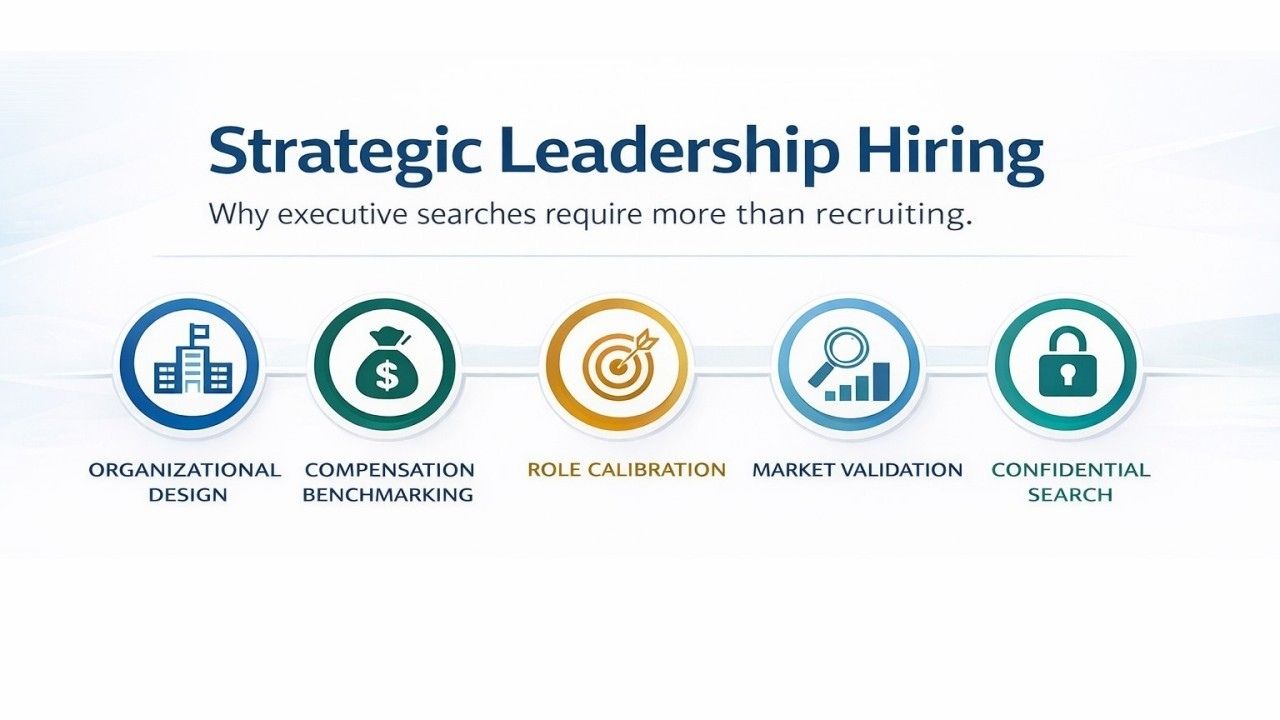
At recruitAbility, we believe that before you start evaluating candidates, organizations begin diving into these elements:
Organizational Design Input: Ensuring the role aligns with long-term strategy and leadership structure.
Compensation Benchmarking: Providing real-time insight into leadership compensation dynamics.
Role Calibration: Aligning stakeholders around expectations before the search begins.
Market Validation: Testing assumptions against the realities of the talent market.
When these elements are addressed early, the recruiting process becomes significantly more effective.
Leadership Hiring Starts with Organizational Design
What does the organization actually need this leader to accomplish?
This sounds simple, but it is frequently where hiring challenges begin.
Job descriptions often reflect historical expectations rather than future strategy. Responsibilities accumulate over time, and leadership roles become a mix of operational tasks, legacy responsibilities, and aspirational goals.
When roles are not clearly calibrated to business objectives, even strong candidates can struggle to succeed.
Organizations that approach leadership hiring strategically often begin with organizational design discussions, examining questions such as:
- How will this role evolve over the next three to five years?
- What decisions will this leader truly own?
- How does the role interact with the existing leadership structure?
- What capabilities are missing from the current leadership team?
Clarifying these elements early dramatically improves the quality of the hiring process.
This is also where experienced external partners can provide meaningful value, offering perspective, facilitating alignment among stakeholders, and ensuring the role reflects the organization’s strategic direction rather than simply its historical structure.
This level of clarity is often what separates organizations that successfully hire leaders who can actually drive change from those that struggle to gain traction during executive searches.
Compensation Benchmarking Is Strategic Intelligence
Another area where leadership searches often break down is compensation alignment.
Executive compensation is rarely as simple as reviewing a salary survey.
Leadership compensation is influenced by:
- company size and growth stage
- leadership scope and reporting structure
- industry competition for talent
- geographic market dynamics
- long-term incentive structures
Static compensation reports rarely capture the real-time movement of leadership markets.
Organizations working closely with the leadership talent market often have access to more nuanced insight into:
- what leaders are currently earning
- what motivates leadership transitions
- how compensation expectations are shifting across industries
This information becomes critical when designing a leadership role capable of attracting the right caliber of candidate.
Role Calibration: Aligning Expectations Before the Search Begins
Another common challenge in leadership hiring is role calibration.
Different stakeholders often have different expectations for the same position.
The board may envision a strategic visionary. The CEO may want a strong operator. The leadership team may expect a collaborative partner.
Without alignment, candidates can enter the process facing conflicting expectations.
This is one reason many leadership searches stall midway through the process.
Organizations that succeed at leadership hiring typically invest time aligning stakeholders around:
- what success looks like in the first 12 months
- what strategic outcomes the role is responsible for
- which leadership competencies are essential
- which capabilities are simply desirable
This level of clarity significantly improves both candidate evaluation and long-term success.
Market Validation: Testing the Role Against Reality
One of the most overlooked parts of leadership hiring is market validation.
Organizations sometimes design leadership roles based on internal assumptions about the talent market.
But those assumptions do not always align with reality.
Market validation involves testing questions such as:
- Does the compensation align with market expectations?
- Is the role scope realistic compared to similar positions?
- Are the required skills actually available in the market?
- How competitive is the talent landscape for this role?
Organizations that validate these assumptions early avoid the frustration of launching searches that struggle to gain traction. Without that early alignment, searches often drift off course; recruiters may present candidates who appear qualified on paper but ultimately do not match the true needs of the role. The result is wasted time for hiring teams, candidates, and recruiters alike. Establishing clarity upfront helps ensure the search begins with the right expectations and attracts the right caliber of leadership talent.
The Role of Confidential Searches
Another important factor in leadership hiring is confidentiality.
Many leadership searches cannot be conducted publicly.
Organizations may be:
- replacing an underperforming leader
- restructuring leadership teams
- preparing for expansion or transformation
- exploring strategic shifts within the organization
Posting these roles publicly can create internal disruption, uncertainty within teams, or even reputational risk.
This creates a natural tension for internal recruiting teams. Conducting confidential searches internally can place them in difficult positions, balancing transparency with discretion while managing internal relationships.
External recruiting partners often play a critical role in these situations by providing a neutral and confidential search process, allowing organizations to evaluate leadership changes without creating unnecessary disruption.
Leadership Hiring Under Board-Level Pressure
For board members, private equity partners, and executive leadership teams, hiring a senior leader is rarely a routine decision.
These hires often take place during moments of significant pressure for the organization.
A company may be entering a new phase of growth. Operational performance may need to improve. A leadership transition may be necessary to support the next stage of strategy.
In many cases, the individuals responsible for these decisions carry a tremendous level of accountability. The success or failure of a leadership hire can influence company performance, investor confidence, and the stability of entire teams.
That reality can make leadership hiring feel high-stakes and, at times, overwhelming.
When organizations approach leadership hiring with the level of intentionality it deserves, the process begins to shift. Conversations move beyond simply filling a position and toward defining the leadership role the organization truly needs for its next stage of growth.
Instead of reacting to candidate pipelines or rushing to evaluate resumes, leadership teams gain clarity around the structure of the role, how it fits within the broader organization, and what outcomes the leader must ultimately drive.
That clarity changes the dynamic of the search.
The process becomes less about reacting to candidates and more about executing a thoughtful leadership strategy.
For boards and executive teams responsible for making these decisions, that shift can make a meaningful difference, not only in the caliber of leaders they bring into the organization, but in the confidence behind the decision itself.
Final Thought
Leadership hiring will always involve uncertainty.
But organizations that approach these decisions casually are almost guaranteed to feel the consequences.
When leadership roles are launched without clear alignment around scope, compensation, market realities, and long-term expectations, the search itself becomes more difficult. The wrong candidates enter the process. Stakeholders pull in different directions. And even when a hire is made, the leader often steps into a role that was never clearly defined to begin with.
That is how leadership hires fail.
The organizations that consistently succeed understand something critical: leadership hiring is not simply a recruiting task. It is a strategic decision about how the company intends to operate, grow, and compete.
And in today’s environment, where talent and strategy are inseparable, approaching leadership hiring with that level of clarity is no longer optional.
It is a competitive advantage.
Related Articles
Executive Hiring: Reducing the Risk of Mis-Hires
The True Hidden Cost of an Open Role
When Internal Recruiting Hits Its Ceiling