
When Manufacturing Hiring Breaks Down Internally
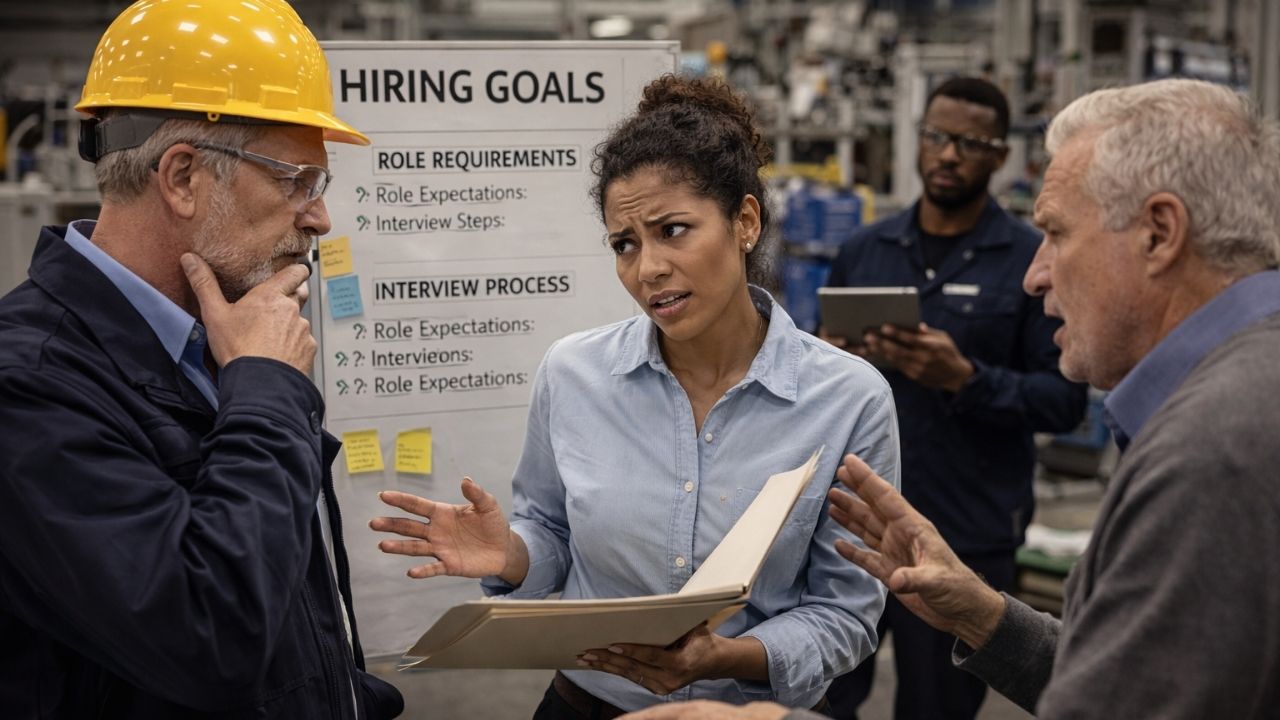
Manufacturing hiring often breaks down long before candidates enter the process. Many manufacturing hiring problems start internally, where misalignment, unclear expectations, and competing operational priorities create friction that slows decision making and weakens candidate engagement. By the time hiring teams recognize the issue, strong candidates have already disengaged or timelines have stretched beyond what the business expected.
Unlike many corporate hiring environments, manufacturing roles operate inside complex operational structures. Production, maintenance, quality, and plant leadership all influence what success looks like. When those perspectives are not aligned, hiring becomes reactive. Candidates receive mixed signals, evaluation criteria shift, and decisions stall.
This internal breakdown becomes more visible in competitive labor markets where experienced operators and plant leaders have options. Organizations that cannot align internally often struggle to maintain momentum. This broader hiring pressure is explored in Recruiting Manufacturing and Operations Talent in Tight Labor Markets, where leadership clarity and operational alignment become critical to attracting talent.
Role definition breaks down before the search begins
One of the most common internal breakdowns occurs at the role definition stage. Different stakeholders often envision different outcomes. Operations leaders may prioritize output stability. Maintenance may prioritize equipment reliability. Quality may emphasize compliance. HR may focus on leadership behaviors.
When these expectations are not aligned, the job description becomes overly broad or inconsistent. Hiring teams begin searching without clear criteria. Interview feedback then reflects conflicting priorities.
Candidates experience this as confusion. One interviewer emphasizes process discipline. Another focuses on speed. A third highlights team development. Candidates struggle to understand what success actually looks like.
This misalignment often extends timelines. Hiring teams must recalibrate expectations mid-process. Interviews are repeated. Candidates wait for clarity. Momentum disappears.
Clear role definition requires leadership alignment before sourcing begins. Without it, hiring becomes reactive.
Plant leadership misalignment slows decisions
Plant leadership plays a central role in manufacturing hiring. When leaders disagree on priorities, decision making becomes difficult. Feedback varies and hiring teams hesitate to move forward.
For example, one leader may value hands-on experience while another prioritizes strategic leadership. Candidates who appeal to one stakeholder may concern another. Hiring teams then delay decisions while reconciling feedback.
This dynamic is closely tied to Why Plant Leadership and Hiring Are Connected, where leadership alignment shapes hiring outcomes. When plant leaders share expectations, decisions move faster. When alignment is missing, hiring slows.
Leadership misalignment also affects candidate perception. Candidates recognize when interviewers disagree. This reduces confidence and increases hesitation.
Unrealistic expectations create evaluation friction
Manufacturing hiring often breaks down when expectations exceed operational reality. Stakeholders may seek candidates with extensive experience across multiple environments, leadership strengths, and technical expertise. These profiles are rare.
Hiring teams may reject strong candidates because they do not match every requirement. The search continues while operational pressure increases. Eventually, expectations may shift, but by then strong candidates are gone.
Unrealistic expectations often reflect internal misalignment. Stakeholders may not agree on which skills matter most. Without prioritization, hiring criteria become too rigid.
This dynamic contributes to longer hiring timelines discussed in Why Manufacturing Roles Take Longer to Fill, where specialization and operational risk narrow candidate pools.
Clear prioritization improves hiring outcomes. Leadership must define must-have capabilities versus preferred experience.
Competing operational priorities delay hiring
Manufacturing leaders balance production, safety, and staffing simultaneously. Hiring decisions often compete with daily operational demands. Interviews are postponed. Feedback is delayed. Candidates wait.
This delay creates risk. Strong candidates often evaluate multiple opportunities. When communication slows, engagement drops. Hiring teams may lose candidates without realizing it.
Operational pressure also affects decision quality. Leaders may defer decisions until production stabilizes. This extends timelines further.
Structured hiring processes help reduce this friction. Scheduling interviews in advance and aligning decision timelines improves consistency.
Inconsistent interview participation creates confusion
Manufacturing hiring often involves multiple stakeholders. Production, maintenance, and HR each participate. When participation varies, feedback becomes inconsistent.
Some candidates may meet certain stakeholders while others do not. Evaluation criteria shift. Hiring teams struggle to compare candidates objectively.
Candidates also interpret inconsistent participation as internal misalignment. This reduces confidence. Hesitation increases.
Consistent interview structure improves clarity. All candidates should meet the same stakeholders when possible. Evaluation becomes more comparable.
Feedback delays disrupt hiring momentum
Timely feedback is critical in manufacturing hiring. When stakeholders delay responses, hiring teams cannot move forward. Candidates wait for updates.
Delayed feedback often results from competing priorities. Leaders focus on production and postpone hiring decisions. This pattern slows momentum.
Candidates may interpret delays as lack of interest. Engagement weakens. Some withdraw silently.
Structured feedback timelines reduce this risk. Leaders should commit to review windows. Hiring teams can maintain progress.
Misaligned compensation expectations create stalls
Compensation misalignment often appears late in manufacturing hiring. Candidates progress through interviews only to discover compensation does not match expectations.
This disconnect often reflects internal misalignment. Stakeholders may not agree on pay range. Hiring teams may lack flexibility.
Late-stage compensation conflicts create delays. Negotiations extend timelines. Candidates may disengage.
Clear compensation alignment early in the process improves efficiency. Candidates appreciate transparency.
Internal communication gaps weaken candidate experience
Manufacturing hiring often involves multiple communication points. HR, hiring managers, and recruiters may each interact with candidates. When messaging differs, candidates become uncertain.
Inconsistent communication suggests internal misalignment. Candidates question whether expectations are clear. Hesitation increases.
Structured communication improves confidence. Consistent messaging reinforces alignment.
This also relates to candidate behavior explored in What Operations Candidates Look for Before Saying Yes, where clarity and leadership alignment influence acceptance decisions.
Process discipline gaps create hiring inconsistency
Hiring processes in manufacturing environments sometimes lack structure. Interview steps may change. Evaluation criteria may shift. Decisions may be revisited.
This inconsistency creates confusion. Candidates experience different processes. Hiring teams struggle to compare feedback.
Structured hiring improves outcomes. Defined steps and criteria support consistency. This approach aligns with Hiring for Reliability, Safety, and Process Discipline, where disciplined evaluation improves decision quality.
Process discipline also improves candidate experience. Predictable steps build confidence.
Stakeholder risk tolerance differences slow decisions
Different stakeholders often have different risk tolerance. Some prefer cautious hiring. Others prioritize speed. These differences create friction.
Hiring teams may debate candidate readiness. Decisions stall. Candidates wait.
Clear leadership alignment reduces this friction. Shared expectations improve decision speed.
Risk tolerance should be defined early. Hiring teams benefit from clarity.
Internal breakdowns reduce candidate confidence
Candidates evaluate hiring processes as indicators of operational maturity. Internal breakdowns signal potential challenges. Candidates may question leadership alignment.
Strong candidates often disengage quietly. Hiring teams may assume candidates lost interest. In reality, candidates lost confidence.
This pattern connects to The Business Cost of Getting Hiring Decisions Wrong, where misalignment affects operational performance and hiring outcomes.
Internal clarity improves candidate confidence. Consistent processes reinforce credibility.
Preventing internal hiring breakdowns
Manufacturing hiring improves when leadership aligns early. Role definition becomes clearer. Evaluation criteria become consistent. Decision timelines improve.
Structured communication supports alignment. Consistent interview participation improves feedback. Clear compensation ranges reduce negotiation delays.
Leadership discipline reduces hiring friction. When expectations are clear, hiring becomes more predictable.
Manufacturing hiring rarely breaks down because of candidate availability alone. Internal alignment often determines success. Organizations that address internal breakdowns improve hiring outcomes and reduce delays. Many of the most common alignment issues and decision points are also addressed in Manufacturing Hiring FAQ: Answers to the Most Common Plant Hiring Challenges, particularly around expectations, evaluation criteria, and leadership consistency.
Related Articles
Recruiting Manufacturing and Operations Talent in Tight Labor Markets
Why Manufacturing Roles Take Longer to Fill
Hiring for Reliability, Safety, and Process Discipline
What Operations Candidates Look for Before Saying Yes
Why Plant Leadership and Hiring Are Connected
The Business Cost of Getting Hiring Decisions Wrong
Manufacturing Hiring FAQ: Answers to the Most Common Plant Hiring Challenges