
The Manufacturing Leadership Pipeline AI Can’t Replace
Written by Michelle Carlberg
Something is happening on America’s factory floors right now that most organizations are not talking about loudly enough.
And by the time they do, it will already be too late to fix easily.
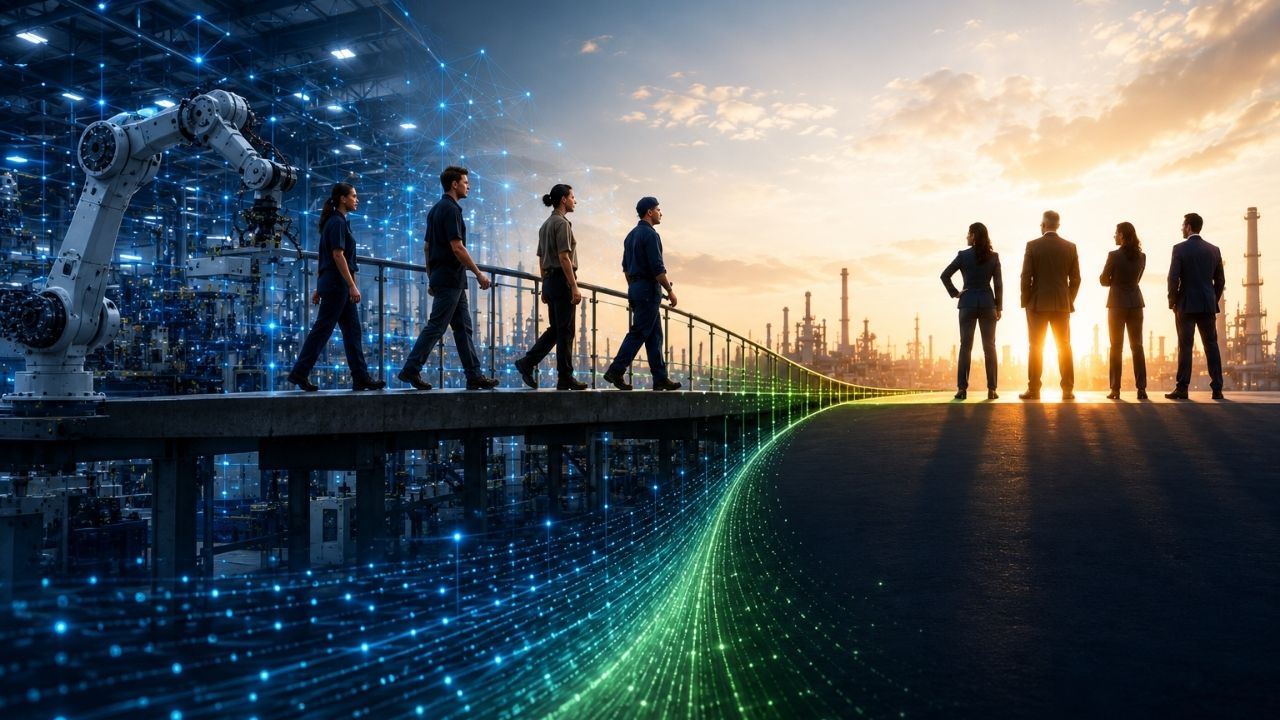
The manufacturing leadership pipeline is under pressure from two powerful forces that are reshaping the industry at the same time.
Manufacturing is experiencing extraordinary growth while AI and automation continue transforming how work gets done.
Organizations trying to recruit manufacturing leaders today are operating in one of the most competitive talent markets in years, which connects closely to Recruiting Manufacturing, Operations, and Construction Talent in Tight Labor Markets.
Individually, neither trend is a problem.
Together, they could fundamentally reshape where tomorrow’s manufacturing leaders come from.
Why the Manufacturing Leadership Pipeline Is Under Pressure
Manufacturing is experiencing two seismic forces simultaneously.
The first is extraordinary growth.
Reshoring is surging. Data centers, semiconductor fabs, advanced manufacturing facilities, and industrial infrastructure are being built at a pace this country has not seen in generations.
Approximately 415,000 manufacturing jobs are currently unfilled in the U.S., with projections showing 2.1 million positions potentially going unfilled by 2030, a shortage that could cost $1 trillion in economic output annually.
The second is AI.
Automation is accelerating across every level of the factory floor. Robotics, agentic AI, and intelligent systems are absorbing tasks that used to justify large entry-level hiring cohorts. Companies are running leaner. Junior roles are shrinking. And on the surface, the productivity numbers look good.
Here is the problem.
Those two forces are not just running side by side.
They are on a collision course.
And the casualty, if organizations are not deliberate right now, could be the manufacturing leadership pipeline itself.
The Entry Ramp Is Closing
For decades, manufacturing built its leaders the same way it built everything else, from the ground up.
You hired someone onto the floor. They learned the work. They learned the machine, the process, and the rhythm of how a facility actually runs. The good ones developed judgment, the kind of judgment you only get from being in the middle of something that went wrong and figuring out how to fix it.
They became team leads.
Then supervisors.
Then plant managers and operations directors.
The entry-level role was not just a job.
It was the first rung on a ladder that produced the leaders every manufacturer in the country depends on.
If AI absorbs too much of that developmental layer and leaders respond by simply reducing headcount without redesigning how talent develops, the impact will not be immediate. Productivity may even improve in the short term. But the risk will show up later. Five years from now, the bench will be thinner, with fewer subject-matter experts, fewer professionals who truly understand how the business operates, and fewer individuals who have built solid judgment through real-world experience.
Traditional assembly roles are declining while demand is growing for technicians who can work with robotics, maintain advanced equipment, and use data to keep production running smoothly.
The entry ramp is not disappearing.
But it is narrowing.
And the organizations that are not redesigning how talent moves through that ramp are quietly dismantling the pipeline that will produce their next generation of leaders.
Organizations that reduce entry-level opportunities today may not feel the impact immediately, but the long-term effect is often a weaker leadership bench, which connects closely to The Hidden Cost of Replacing Entry-Level Talent With AI.
What AI Is Actually Doing to Manufacturing
Let me be clear about something, because this conversation gets distorted quickly in both directions.
AI is not replacing manufacturing.
It is transforming it.
More than 81 percent of task hours in manufacturing are expected to remain human-driven. The most successful AI implementations position it as an employee-augmentation technology that empowers workers to perform at higher levels, freeing them from repetitive, data-intensive tasks so they can focus on work requiring judgment, problem-solving, and creativity.
While AI will displace an estimated 2 million manufacturing jobs by 2026, it is also projected to create 170 million new jobs globally by 2030, a net gain of 78 million positions. Most manufacturing roles will transform rather than disappear, with workers moving into supervisory, maintenance, and analytical positions that AI cannot perform.
The roles requiring complex problem-solving, physical dexterity, and human judgment are not disappearing.
They are becoming more critical and more difficult to fill.
Industrial machinery mechanics.
Electricians.
CNC machinists.
Welders.
Maintenance technicians.
Process engineers.
Quality leaders.
Operations managers.
These are the roles manufacturing cannot automate away.
They are also the roles manufacturers cannot find enough people to fill.
The organizations succeeding in this environment are investing in the professionals who keep operations reliable, safe, and productive, which is something we explored further in Hiring for Reliability, Safety, and Process Discipline.
Roles like maintenance technicians, CNC machinists, and industrial electricians are among the hardest to fill. The driver is not surging demand alone. It is the combination of a retiring workforce and a thin pipeline behind them.
The Middle Management Squeeze Nobody Is Naming
Here is the part of this story that is not being discussed nearly enough.
Reports now indicate that work previously handled in early-career roles is simply being pushed upward, leaving middle management and senior talent overextended, burned out, and increasingly disengaged as they absorb junior tasks.
Think about what that means for a plant manager or operations director.
AI is handling more routine work at the entry level.
But institutional knowledge, contextual judgment, mentorship, and oversight are not being automated.
They are being absorbed by leaders who were already stretched.
And in manufacturing specifically, where judgment is built by troubleshooting a line stoppage at 2 a.m., recovering from a failed project, or solving production problems under pressure, the removal of that developmental environment is not simply a technology issue.
It is a leadership crisis unfolding in slow motion.
Why the Manufacturing Leadership Pipeline Is Running Dry
Let me put the full picture together, because when you see it as a whole, it is genuinely alarming.
Manufacturing needs 2.1 million additional workers by 2030.
Roughly half of the current skilled workforce is over 50 and approaching retirement.
AI is compressing entry-level roles, narrowing the traditional pathway into leadership.
Shifting immigration policies may further impact the labor pool, since immigrant workers filled nearly one in four U.S. manufacturing production jobs in 2024.
AI-related skills now appear in 2.5 percent of all U.S. job postings, a 297 percent increase over the past decade.
The skills the factory floor requires are evolving faster than organizations are developing people to meet them.
And the pipeline that once produced great manufacturing leaders through years of accumulated experience, mentorship, and progressive responsibility is under more pressure than it has ever been.
Leadership shortages rarely appear overnight. They develop gradually as organizations lose opportunities to build experience from the ground up, which connects closely to Why Plant Leadership and Hiring Are Connected.
The manufacturing and construction industries offer a clear example. As apprenticeship pipelines slowed and experienced workers retired without enough overlap, the gap did not appear overnight. It developed gradually, eventually leading to thinner benches and skilled roles that are increasingly difficult to fill.
This is not a future problem.
It is a present one.
And many organizations are optimizing their way into it, one efficiency decision at a time.
What the Strongest Manufacturers Are Doing Differently
The answer is not to resist AI.
The answer is to be intentional about what AI cannot replace and build deliberately around it.
Today’s leaders have the opportunity to advance both efficiency and people. They can balance AI-driven productivity gains with continued investment in the lower levels of the talent pyramid, creating a workforce that is prepared for tomorrow’s manufacturing environment.
Deloitte’s framework for manufacturing workforce strategy is instructive: Build, Buy, or Borrow.
Build means investing in the talent most critical to the business through wages, skills, and employee experience.
Buy means hiring experienced professionals when internal development cannot move fast enough.
Borrow means using flexible workforce solutions to support periods of rapid growth without permanently expanding headcount.
That framework closely reflects how the most agile manufacturers are approaching today’s market.
The organizations navigating growth most successfully are treating recruiting as part of their operational strategy instead of a reactive function, which connects closely to The Most Expensive Hiring Mistake Manufacturers Are Making.
Where Partnership Changes the Equation
No internal recruiting team is equipped to execute all three of those strategies simultaneously, especially during periods of rapid growth, compressed timelines, and talent scarcity.
That is precisely where a recruiting partner who understands manufacturing at the operational level changes the equation.
Not by replacing your internal team.
By extending its capabilities exactly where they are needed most.
The strongest recruiting partnerships don’t simply help organizations fill openings. They strengthen long-term hiring capability, which connects closely to Why Strong Recruiting Partnerships Produce Better Hiring Outcomes.
Whether the challenge involves plant managers, operations directors, process engineers, maintenance leaders, facility expansions, or large-scale hiring initiatives, strategic recruiting support gives organizations the flexibility to grow without sacrificing hiring quality.
The Conversation That Needs to Start Today
Manufacturing is not in crisis because AI is taking over.
Manufacturing is at a crossroads because extraordinary growth and accelerating automation are colliding with a leadership pipeline that was already under strain.
The organizations that treat this as an operational and strategic challenge, not simply an HR issue, will be the ones that come out ahead.
That means investing in the people already on the floor, not simply optimizing their roles away.
It means sourcing experienced leadership talent that will never come through a job posting.
It means planning for 2028 instead of only the next quarter.
And it means recognizing where internal recruiting capacity ends and strategic partnership begins.
The factory of the future will absolutely be powered by AI.
But it will still be led by people.
People who need to be found, developed, and invested in, starting today.
Related Articles
Recruiting Manufacturing, Operations, and Construction Talent in Tight Labor Markets
The Hidden Cost of Replacing Entry-Level Talent With AI
The Texas Bottleneck: Building Faster Than Texas Can Hire
Why Plant Leadership and Hiring Are Connected
Hiring for Reliability, Safety, and Process Discipline
Manufacturing Hiring FAQ: Answers to the Most Common Plant Hiring Challenges