
Most Customer Success Leaders Were Never Trained to Drive Revenue
There’s a shift happening right now… and most companies aren’t ready for it.
Companies are pushing Customer Success to own revenue. Not just retention. Not just relationships. Revenue. Expansion. Growth.
On paper, the logic is clean.
CS sits closest to the customer. They understand usage, risk, value, and opportunity better than anyone. So the thinking becomes: they should own expansion too.
Here’s the problem.
Most Customer Success leaders were never trained to do that.
Why the gap is showing up now
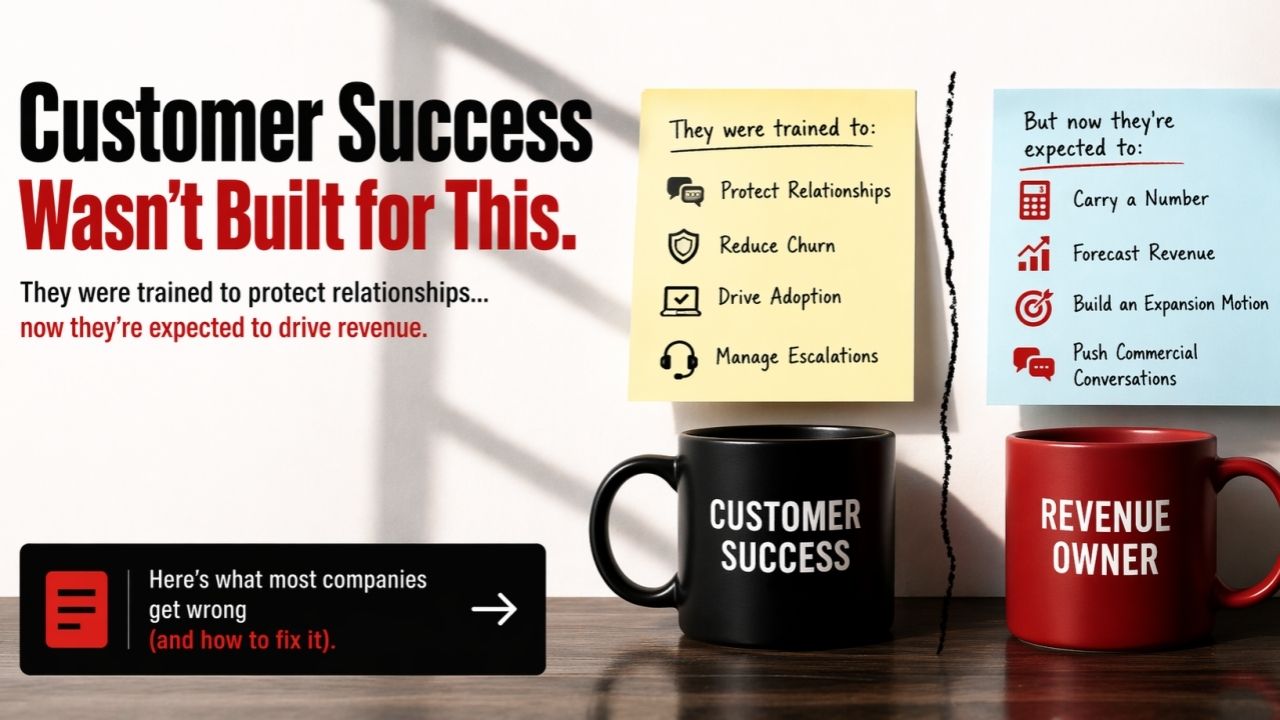
They were trained to protect relationships, reduce churn, drive adoption, and manage escalations. That’s a fundamentally different skill set than carrying a number, forecasting revenue, building an expansion motion, and pushing commercial conversations.
And that gap is showing up in real ways.
The expectation changed. The profile didn’t.
The economics already made the case
Acquiring a new customer costs significantly more than retaining and expanding an existing one.
The math has already settled this.
Expansion isn’t a nice-to-have. It’s one of the highest-leverage growth plays in a subscription business.
Expansion ARR now represents a meaningful portion of total new ARR, and for larger companies, it often becomes the majority.
Boards aren’t asking about Net Revenue Retention because it sounds good. They’re asking because it directly impacts enterprise value.
And yet most companies still spend aggressively to acquire new customers while under-leveraging the ones they already have.
Customer Success has the advantage… but not the structure
Customer Success has a structural advantage Sales doesn’t.
They’re already inside the account. The trust is already built. The data is already there.
That advantage just isn’t being monetized.
Because the person leading the function was never wired to think that way.
What the profile gap actually looks like
I’m in the middle of a VP of Technical Customer Success search right now. And the pattern is consistent across candidates.
Strong people. Leaders who have built teams, supported enterprise accounts, created operational rhythms, and understood the post-sale motion deeply.
But when you look closer… they’ve never owned the number.
They’ve influenced it. Supported it. Helped enable it. Not owned it.
And that’s not a minor distinction. It changes how someone sees the job entirely.
A revenue owner thinks in pipeline, not just relationships. They push uncomfortable conversations, prioritize expansion opportunities over keeping things smooth, and make trade-offs based on revenue impact.
Underneath all of that, they’re constantly asking whether the motion itself is correctly built… not just whether they’re executing it well.
A relationship-focused operator optimizes for satisfaction. Avoids friction. Protects the account. Escalates when needed.
Both are valuable. They are not the same person.
The deeper issue isn’t skill
The deeper issue isn’t skill.
It’s mindset… and mindset follows compensation.
If expansion was never tied to your number, you never had to develop the instincts that come with owning it.
The pressure didn’t demand it. So the muscle never formed.
Asking someone to suddenly operate like a revenue owner, without that background, is where things break.
This is where hiring decisions often go sideways. Teams assume capability will stretch to match expectations, instead of aligning the role with the right profile upfront. It’s a dynamic we’ve seen repeatedly in The Hidden Cost of a Bad Hire: Why Recruitment Strategy Matters.
What happens when the gap goes unaddressed
You end up with a function that’s supposed to drive growth but behaves like a support layer.
No real expansion motion.
>No predictable revenue from the base.
>No accountability tied to outcomes.
And eventually, leadership starts questioning the function instead of the hire.
The org chart changed. The profile didn’t.
That’s the actual problem.
The fix… and the honest reality
The straightforward answer is: hire someone who has owned revenue inside a CS seat.
A former AE who moved post-sale and stayed commercial.
A CS leader who came up through account management with quota history.
Someone who has felt the pressure of a number and learned how to operate inside it.
Because once you’ve owned revenue, you see the same customer relationships differently. The conversation shifts. The priorities reorder. The instinct to expand becomes natural instead of forced.
But here’s the honest part.
That pool is small.
Sales is a different discipline. It takes a specific wiring that not every CS leader wants to develop… and finding someone currently doing both well, in your space, is harder than most job descriptions account for.
The unicorn search is real.
And stalling while you wait for that person costs the business.
So what do you actually do?
If your CS leader is strong but not wired for revenue ownership:
Don’t force the transition. Build a commercial overlay.
If you’re searching for someone who has done both:
Narrow the search correctly. Prioritize quota ownership, expansion responsibility, and post-sale depth.
If you’re building the muscle from inside:
Tie compensation to expansion. Give controlled reps. Let the mindset follow the incentive.
The through line across all three:
Structure has to carry what the profile can’t.
Final thought
Customer Success doesn’t become a revenue function because you changed the org chart.
It becomes one when you change who you hire to lead it… or when you build the structure honest enough to bridge the gap until that person exists.
Everything else is just hope.
And hope doesn’t show up in your numbers.
Related Articles
The Hidden Cost of a Bad Hire: Why Recruitment Strategy Matters
Hiring Right Now: Why Finding Talent Feels Impossible, and What to Do About It