
Why Hiring Ownership Matters More Than Hiring Support
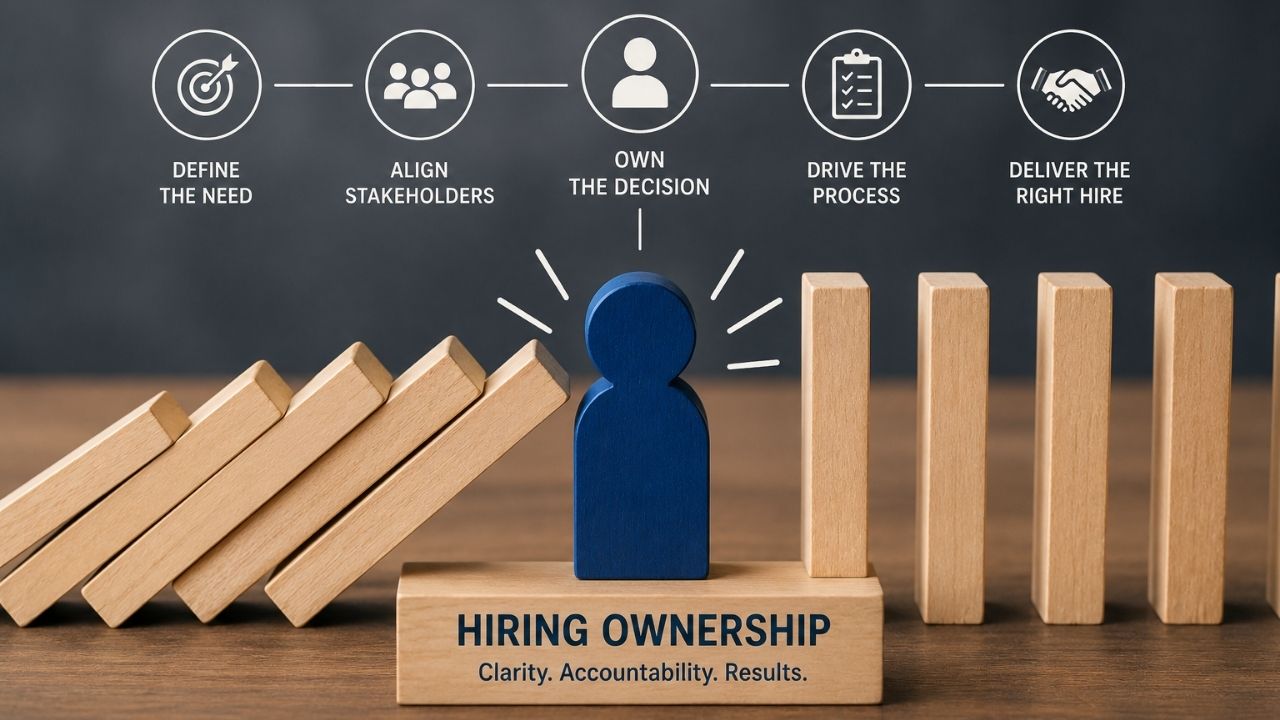
Hiring support helps move work forward. Hiring ownership drives outcomes.
At first, those ideas can sound interchangeable. Recruiters source candidates, coordinate interviews, manage communication, and support hiring managers throughout the process. From the outside, that activity appears connected to hiring success.
However, support and ownership operate very differently once hiring becomes more complex.
This distinction becomes especially important when organizations begin struggling with stalled searches, delayed decisions, and inconsistent hiring outcomes. In many cases, teams assume they need additional recruiting support when the real issue is that no one fully owns the process from start to finish.
As a result, work continues while momentum disappears.
This is one of the most common structural problems inside modern hiring systems. Everyone participates, yet no one is truly accountable for driving the search toward resolution.
That gap between participation and accountability is where many hiring systems begin to break down.
Why hiring ownership changes how decisions get made
Ownership creates accountability for outcomes, not just activity.
When one person or one clearly aligned team owns the hiring process, decisions move differently. Priorities stay clearer. Communication remains more consistent. Delays are identified and addressed earlier.
Support models, on the other hand, often focus primarily on execution. Recruiters source candidates, schedule interviews, and manage process logistics. While those responsibilities are important, they do not automatically create accountability for hiring outcomes.
This distinction matters because hiring systems become increasingly complex as organizations grow. More stakeholders become involved. Role expectations evolve. Decision-making slows.
Without ownership, those issues compound quickly.
In practice, support keeps activity moving. Ownership keeps decisions moving.
This distinction is directly connected to Choosing the Right Recruiting Model for Your Business, where structure determines whether hiring systems can scale effectively.
Why support alone often creates stalled hiring systems
Support models work well when organizations already have strong internal alignment. If hiring managers communicate clearly, expectations remain stable, and decision-making stays consistent, additional recruiting support can improve efficiency.
However, many organizations operate without that level of alignment.
In those environments, support alone tends to expose structural weaknesses rather than solve them.
Recruiters continue sourcing candidates, but stakeholders disagree on evaluation criteria. Interviews continue, but role expectations shift midway through the process. Communication happens regularly, yet no one drives difficult decisions toward resolution.
As a result, the system remains active while momentum declines.
This is one reason hiring can feel extremely busy without producing forward progress, a pattern explored further in When Hiring Feels Busy but Nothing Moves Forward.
Why ownership becomes more important as hiring complexity increases
Hiring complexity increases faster than most organizations expect.
At first, a relatively simple recruiting structure can support growth effectively. A small recruiting team works closely with hiring managers, communication stays informal, and roles move quickly through the process.
However, as organizations scale, complexity increases dramatically.
More stakeholders become involved in hiring decisions. Multiple teams compete for recruiting attention. Specialized roles require deeper evaluation and alignment.
This is where support models often begin struggling.
Recruiters may continue executing tasks effectively, but without clear ownership, the system becomes harder to coordinate. Decisions slow because no one is fully accountable for maintaining alignment across the process.
Over time, hiring begins consuming more energy while producing less momentum.
Scenario: Multiple recruiters supporting the same search
A company opens a high-priority leadership role and assigns several recruiters to support the search.
Initially, this appears effective. Candidate outreach increases, pipelines expand, and interviews begin quickly.
However, problems emerge as the process continues.
Different recruiters position the role differently with candidates. Hiring managers receive inconsistent updates. Feedback loops slow because multiple people are coordinating communication across stakeholders.
At first, leadership assumes the issue is candidate quality or market conditions. In reality, the problem is ownership.
Multiple people support the search, but no one fully owns the process from beginning to end.
As a result, momentum breaks down despite increased activity.
This is one reason more recruiters alone rarely improve hiring systems, a challenge explored further in Why More Recruiters Doesn’t Fix Broken Hiring Systems.
Why ownership improves hiring momentum
Hiring momentum depends on consistent forward movement.
When ownership is clear, that movement becomes easier to sustain. Recruiters know who drives decisions. Hiring managers understand expectations. Stakeholders align earlier because accountability exists throughout the process.
Ownership also reduces hesitation.
Instead of repeatedly revisiting decisions, teams move more confidently because someone is responsible for maintaining direction and alignment.
This becomes increasingly important during complex searches where uncertainty naturally increases over time.
Without ownership, momentum slows because the system becomes reactive. Recruiters wait for feedback. Hiring managers delay decisions. Stakeholders introduce conflicting opinions late in the process.
Eventually, activity continues while progress stalls.
Why candidates notice the difference immediately
Candidates experience ownership differently than organizations do internally.
When a hiring process has strong ownership, communication feels clearer. Expectations stay more consistent. Interview stages feel intentional rather than repetitive.
Candidates sense that the organization understands what it wants and how decisions will be made.
However, when support exists without ownership, the process often feels fragmented.
Candidates may receive inconsistent messaging from different recruiters. Interview conversations may focus on conflicting priorities. Timelines shift repeatedly because stakeholders remain misaligned.
Strong candidates notice those signals quickly.
In competitive hiring environments, experienced professionals often interpret fragmented hiring systems as indicators of broader operational instability. As a result, they disengage earlier in the process.
This is one reason hiring momentum frequently breaks down long before organizations realize candidates are losing confidence.
Scenario: Internal recruiting with no decision ownership
An internal recruiting team supports multiple business units across a growing organization.
Recruiters manage sourcing effectively and maintain strong candidate pipelines. However, hiring managers approach decisions differently across teams.
Some leaders provide feedback quickly. Others delay for weeks. Certain stakeholders continue redefining roles mid-search. Recruiters attempt to keep the process moving, but no single person owns alignment across the system.
Over time, recruiters spend more time coordinating than executing.
Candidates remain in interview stages for too long. Hiring managers become frustrated with pipeline quality. Leadership questions why searches continue slowing despite strong recruiting activity.
In reality, the issue is not recruiting support. It is the absence of ownership.
Why ownership creates operational clarity
Ownership simplifies decision-making because accountability becomes visible.
When ownership exists, everyone understands who drives communication, maintains alignment, and resolves bottlenecks. That clarity reduces uncertainty across the process.
Support models alone often lack that clarity.
Recruiters complete tasks effectively, but difficult decisions remain distributed across too many stakeholders. As complexity increases, that fragmentation slows the process significantly.
This becomes especially visible during high-stakes searches where alignment matters more than activity volume.
In practice, ownership creates operational discipline inside the hiring system. It prevents processes from drifting as pressure and complexity increase.
Why managed recruiting models emphasize ownership
This is one reason managed recruiting models focus heavily on accountability and coordination.
Support alone does not scale effectively when organizations manage multiple searches across teams, locations, or functions. At a certain point, hiring systems require centralized ownership to maintain consistency.
Managed recruiting structures create that alignment by defining accountability clearly across the process.
Recruiters still execute sourcing and pipeline management responsibilities. However, ownership extends beyond activity. The model also drives stakeholder alignment, communication consistency, and decision-making accountability.
This is one reason organizations often shift toward more structured recruiting systems as hiring complexity grows, a transition explored further in Why Mid-Market Companies Shift to Managed Solutions.
Why support and ownership should not be treated as interchangeable
Many organizations unintentionally treat support and ownership as the same thing.
From a distance, both involve recruiting activity. Candidates are sourced. Interviews happen. Pipelines move.
However, the underlying responsibilities differ significantly.
Support contributes to the process. Ownership drives the process forward.
That distinction matters because hiring systems rarely fail due to lack of activity alone. More often, they fail because accountability becomes diluted as complexity increases.
This is exactly what happens when organizations rely on support structures to solve problems that actually require ownership.
How ownership restores hiring momentum
Ownership restores hiring momentum because it creates consistency across the process.
Decision-making becomes clearer. Communication becomes more aligned. Expectations stabilize earlier.
As a result, recruiters spend less time managing process instability and more time driving outcomes.
Candidates move through the system with greater confidence because the process feels structured and intentional. Hiring managers make decisions faster because alignment happens earlier instead of later.
Over time, this creates a calmer and more effective hiring environment even during periods of significant growth or complexity.
What actually fixes hiring systems that rely too heavily on support
Hiring systems improve when organizations stop measuring recruiting effectiveness only through activity volume and begin evaluating accountability instead.
In practice, this starts with ownership clarity. Teams need to understand who is responsible for driving alignment, maintaining momentum, and resolving decision bottlenecks throughout the process.
Stakeholders also need consistent expectations around evaluation criteria and hiring timelines. Without that structure, recruiters spend too much time reacting to shifting priorities instead of executing strategically.
A structured recruiting model connects those elements together. It creates consistency across communication, decision-making, and accountability so hiring systems can continue functioning effectively as complexity increases.
When ownership exists, hiring becomes more predictable and easier to scale. Without it, additional support often creates more coordination challenges instead of better outcomes.
The bottom line on hiring ownership versus hiring support
Hiring support helps organizations manage activity. Hiring ownership helps organizations achieve outcomes.
That distinction becomes increasingly important as hiring systems grow more complex.
Without ownership, recruiters continue working, interviews continue happening, and pipelines remain active. However, momentum slows because accountability becomes fragmented across too many people and processes.
Organizations that recognize this shift stop focusing only on support capacity. Instead, they evaluate whether the hiring system itself has clear ownership, alignment, and accountability.
When those elements exist, hiring becomes faster, more consistent, and significantly easier to scale.
Related Articles
Choosing the Right Recruiting Model for Your Business
When Hiring Feels Busy but Nothing Moves Forward
Why More Recruiters Doesn’t Fix Broken Hiring Systems
Why Mid-Market Companies Shift to Managed Solutions