
Austin Is Booming. The Workforce Isn’t Ready. And the Clock Is Ticking.
Written by Michelle Carlberg
There is a version of Austin’s future that looks extraordinary.
Semiconductor fabs the size of small cities. Data centers stretch across the Central Texas corridor. Tesla, Apple, Samsung, and SpaceX are operating within miles of each other. A manufacturing and technology ecosystem that rivals anything in the country.
That version of Austin is not a projection. It is already under construction.
Austin has claimed the top spot as the number one large economic boomtown in the U.S., driven by a 51 percent surge in GDP fueled by rapid job creation in tech, manufacturing, and professional services. The Greater Austin metro GDP has surpassed $245 billion, with real GDP growth of 39 percent from 2020 to 2025, one of the fastest rates in the nation.
The investment is staggering. Samsung’s $17 billion semiconductor plant expansion in Taylor, Texas is projected for a 2026 completion date and represents one of the largest capital investments in Central Texas history. Nearly 20 data center projects are underway or planned in the Austin area alone, against a backdrop of $500 billion in projected data center investment nationally in 2026.
The opportunity is real. The growth is real.
And the workforce crisis underneath it all is just as real.
The Gap Between Growth and Talent
Here is the uncomfortable truth that often gets lost inside headlines about cranes, groundbreakings, and billion-dollar announcements:
All of this growth requires people. Skilled people. And right now, there are not enough of them.
As of early 2025, 449,000 U.S. manufacturing jobs remain unfilled, nearly half a million open positions in one of the most critical sectors of the economy.
That number is not a temporary dip. It reflects a structural problem years in the making.
A lack of appropriately skilled workers could result in 2.1 million unfilled manufacturing jobs by 2030, a gap that could cost the U.S. economy as much as $1 trillion annually by that same year.
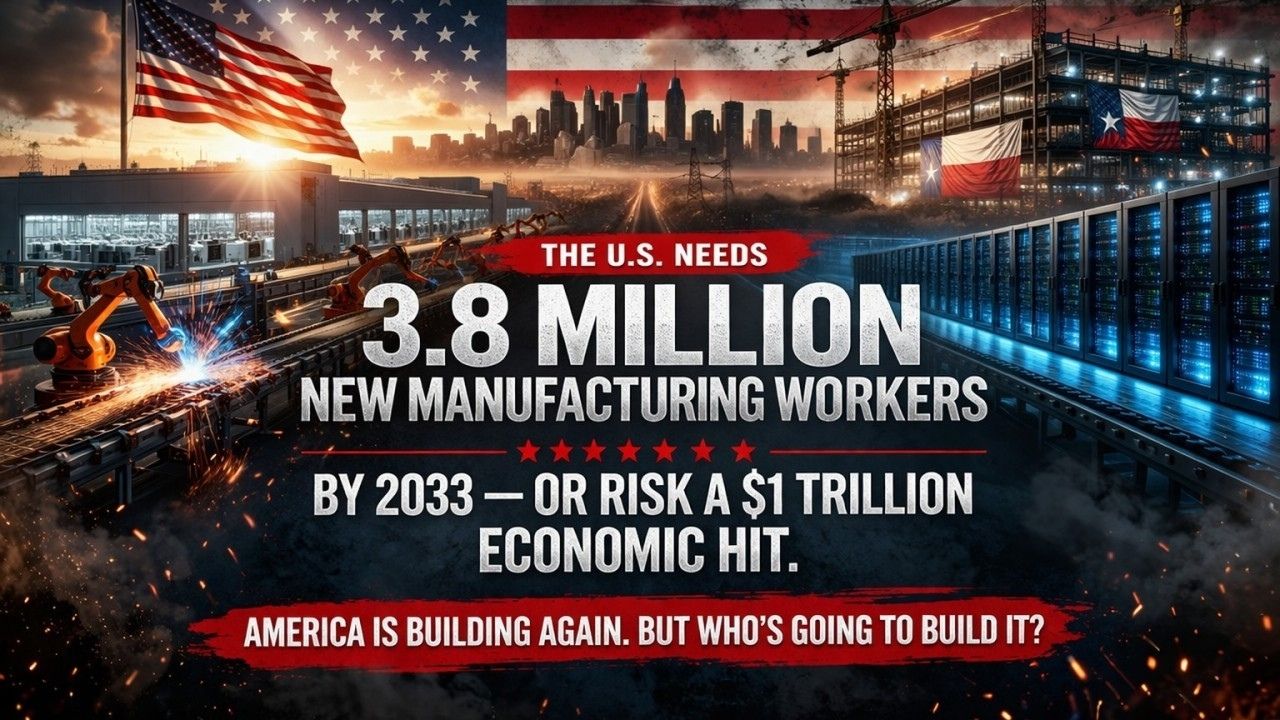
Deloitte and The Manufacturing Institute project that the U.S. manufacturing industry will need as many as 3.8 million new employees by 2033, and as many as 1.9 million of those skilled positions could remain unfilled if manufacturers are not able to address the skills and applicant gaps.
Read that again.
Nearly half of the skilled manufacturing roles expected to open over the next decade may go unfilled. Not because the jobs do not exist, but because the talent to fill them does not yet exist in sufficient numbers.
For a region like Austin, which is building the physical infrastructure of the next American manufacturing era right now, that is not a distant problem. It is an immediate one.
The Leadership Layer Nobody Is Talking About
When conversations about the manufacturing skills gap happen, they tend to focus on the floor: machinists, technicians, operators, skilled tradespeople. And that concern is absolutely valid.
But there is a layer of the workforce that is equally at risk and receives far less attention.
Leadership.
Manufacturing is no longer what it was a decade ago. 95 percent of manufacturing organizations are already using AI across various areas of their business, yet the same research reveals a significant readiness gap. CEOs are 28 percent more likely than chief technology officers to say their organizations are in the early stages of AI implementation and are more likely to favor hiring external talent over upskilling current employees.
That misalignment is costly. And it is happening at the leadership level.
More than one-third of manufacturing executives cite workforce skills as their top talent concern as investment accelerates in automation, analytics, and smart manufacturing.
Nearly half of manufacturing companies, 48 percent, have already started using automation and AI as alternatives to filling open positions. This means the nature of leadership in manufacturing is shifting rapidly. The leaders who succeed in the next phase of this industry will not simply manage headcount and production schedules. They will need to understand automation systems, lead through digital transformation, and develop teams in an environment of continuous technological change.
The leaders who do not adapt will not just fall behind. They will become a liability to the very operations they are meant to run.
This shift is forcing organizations to rethink leadership hiring in manufacturing, particularly as advanced facilities demand leaders who can operate across both operational and technical environments.
Austin’s Specific Challenge
Central Texas is not just experiencing growth. It is experiencing a concentration of technologically advanced industry at a scale and pace that most regions never see.
The Austin–Georgetown–Taylor corridor has become Texas’s industrial research park, an ecosystem anchored by Samsung’s $17 billion fab in Taylor and surrounded by a constellation of suppliers, data facilities, and advanced manufacturers.
In 2026, there is sustained demand for tradespeople possessing hybrid skills in electrical, mechanical, and digital controls roles that sit at the intersection of traditional manufacturing expertise and emerging technology literacy.
This is not a workforce that can be assembled overnight through job postings.
It requires deliberate investment in talent development. It requires pipelines built years before the roles open. And it requires leaders who understand what these facilities actually need…not just today, but in three, five, and ten years.
Austin’s next phase of growth is no longer about whether the region will grow. It is about whether the region can build fast enough, train fast enough, and execute efficiently enough to sustain that growth without eroding the advantages that made Austin successful in the first place.
That framing is exactly right. And the workforce is at the center of it.
The Cost of Waiting
Some organizations are watching this situation develop and choosing to address it later. That approach carries significant risk.
The manufacturing sector’s labor shortage is not just about numbers; it is about skills. While advances in automation and smart manufacturing can reduce the number of workers needed in some areas, the same advances make the labor shortage harder to address because many job seekers lack these specialized skills.
Experts project that 59 percent of employees will need upskilling or reskilling by 2030, especially in industries where technology reshapes day-to-day work.
According to the World Economic Forum’s Future of Jobs Report, 60 percent of workers will need training by 2027, yet only half of workers currently have access to adequate training.
The window to act is narrowing.
Workforce development takes time. Training pipelines take time. Building the leadership bench capable of running advanced manufacturing operations at scale takes time. Organizations that begin investing in that development today will have a meaningful advantage over those that do not.
This is where long-term workforce planning becomes a competitive advantage, especially in regions experiencing concentrated industrial expansion.
What Strong Organizations Are Doing Now
The manufacturers and construction operators navigating this environment most successfully are not waiting for the workforce to appear. They are actively shaping it.
Many are investing in upskilling and reskilling their existing teams before skill gaps become operational crises.
Others are developing leadership pipelines that prepare managers and supervisors for a manufacturing environment shaped by automation, AI, and advanced technology.
Some are also partnering with workforce and talent advisors who understand the technical nature of these roles and the competitive landscape for talent in Central Texas.
And critically, they are treating talent strategy as an operational priority, not an HR afterthought.
For the manufacturing industry to address the labor shortage, not just to recover but to lay the foundation for sustained growth, leaders must invest in their workers, improving the skills of the workers they have while working to attract and train new talent.
That investment is not optional. It is a prerequisite for participating in what Austin is building.
Final Thought
Austin is in the middle of one of the most significant economic transformations any American city has experienced in a generation.
The infrastructure is coming. The investment is committed. The facilities are rising.
What determines whether this region fully captures the opportunity in front of it, and whether the organizations within it keep pace with the growth around them, is the talent strategy decisions being made right now.
The skills gap is real. The leadership gap is real. And the time to address both is not when the next facility opens.
It is today.
I am a talent and workforce strategy partner helping manufacturing, construction, and operations organizations across the United States build the teams and leadership pipelines their growth demands.
The workforce challenges described in this article are not abstract; they are conversations I have with leaders every day. My experience, market knowledge, and strategic insight exist to help you get ahead of them, not react to them.
If you are ready to build a workforce strategy that matches the growth around you, I would love to talk.
Related Articles
The Hiring Surge Trap — And the Smarter Way Out
Why Manufacturing Roles Take Longer to Fill
Why Plant Leadership and Hiring Are Connected
When Manufacturing Hiring Breaks Down Internally