
Central Texas Is Building at a Historic Pace. Is Your Hiring Strategy Keeping Up?
Drive through the Austin corridor on any given morning, and the evidence is impossible to miss.
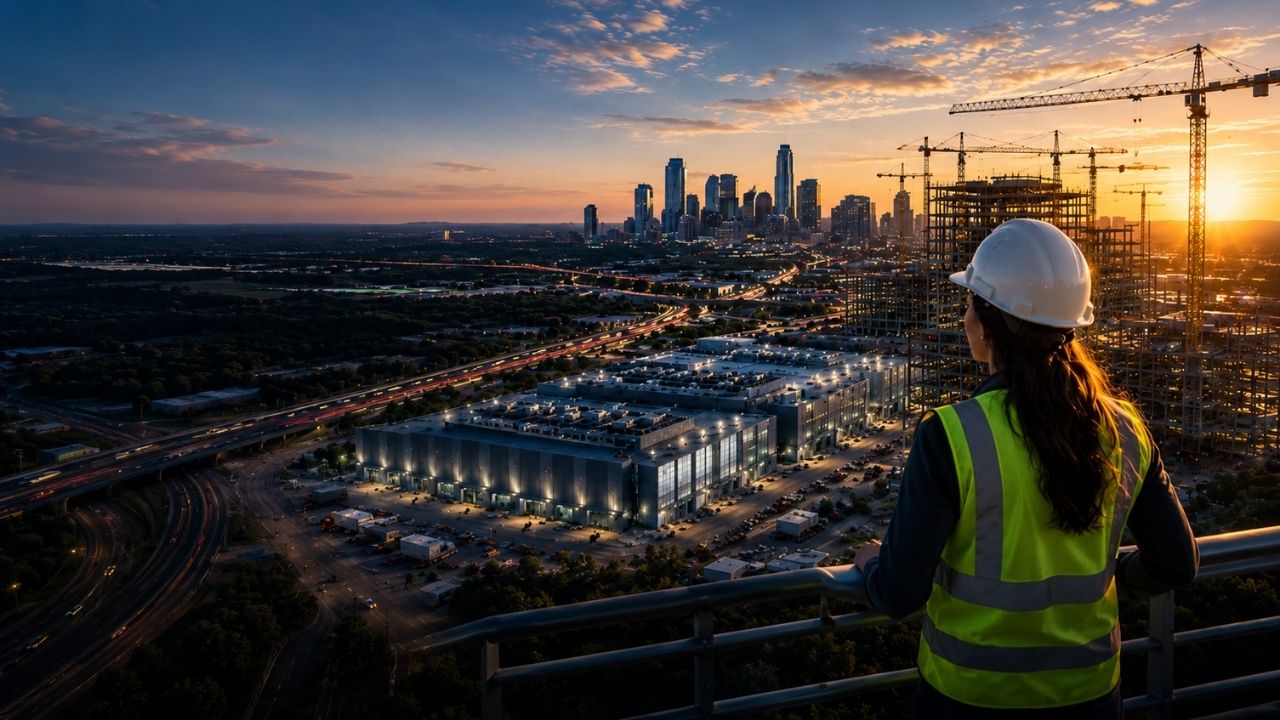
Cranes on the skyline. Foundations being poured. New facilities rising from land that was pasture not three years ago. Construction trailers parked outside projects that will reshape entire communities and require thousands of skilled, specialized, and leadership-level professionals to bring them to life.
Central Texas is not just growing.
The region is transforming rapidly, at a scale most areas never experience.
And for the companies at the center of that transformation, one question is becoming increasingly urgent:
How do you hire for growth you did not fully anticipate without dismantling the operation you have already built?
What Central Texas Hiring Looks Like Right Now
Let me put some numbers around what is actually happening in this region right now, because the scale of it is genuinely extraordinary.
Nearly 20 data center projects are underway or planned in the Austin area alone, against a backdrop of $500 billion in projected data center investment nationally in 2026, with an estimated $3 trillion expected by 2028.
The Tract Caldwell County Park, a 2 gigawatt data center technology park, is being developed on 1,515 acres between Austin and San Antonio. Edged Austin, currently under development, will total more than two million square feet at full build-out, with $7.3 billion in total projected investment and construction running from 2026 through 2028.
The Scale of Expansion Is Accelerating Fast
PEGATRON Corporation, a Taiwanese Fortune Global 500 electronics manufacturer with $35 billion in annual revenue, announced its first U.S. manufacturing facility in Georgetown. Caracol, an Italian advanced manufacturing company, opened its U.S. headquarters in Austin. Goldman Sachs is building a 980,000-square-foot campus in Dallas-Fort Worth.
Southwest Airlines’ pilot hub and T1 Energy’s solar manufacturing facility were among the largest individual announcements in 2025, reflecting both corporate headquarters activity and continued growth in advanced manufacturing, with the top ten announcements alone representing roughly 70 percent of all jobs announced in the region last year.
Texas led the nation in absolute construction job growth, adding 18,500 construction jobs in the past year, anchored by the industrial corridor stretching from Dallas-Fort Worth through Austin to San Antonio.
This is not a regional boom. This is a generational reshaping of the Central Texas economy.
And every single one of those projects needs people.
Specialized people. Experienced people. Leaders who can build and manage teams under pressure, in fast-moving environments, with real operational consequences if the wrong hire is made.
The challenge is that workforce readiness is not scaling at the same pace as the projects themselves, which is something we explored further in Austin Is Booming. The Workforce Isn’t Ready. And the Clock Is Ticking.
The Hiring Problem Nobody Is Talking About Loudly Enough
Here is where it gets complicated.
Most of the companies driving this growth, particularly those entering the Central Texas market for the first time, are not local organizations with established talent pipelines, deep community relationships, and a recruiting infrastructure built for this geography.
They are organizations scaling fast, in some cases hiring hundreds of people across multiple roles simultaneously, while their internal teams are already stretched managing the growth they already have.
And the instinct in that moment is predictable.
Post the jobs. Lean on the applicant tracking system. Ask the internal HR team to handle it.
That approach works beautifully for high-volume, entry-level, and easily replaceable roles.
It works far less well for the roles that actually determine whether a facility opens on time, operates safely, performs to plan, and builds the kind of team that holds together when the pressure is highest.
Why Traditional Hiring Strategies Stop Working
According to the Associated General Contractors of America, 92 percent of construction firms report difficulty hiring qualified workers in 2026, and the industry needs 349,000 net new workers this year alone, rising to 456,000 in 2027.
In Texas specifically, 76 percent of contractors report significant difficulty filling hourly craft positions, while 78 percent struggle to staff salaried roles, reflecting a systemic problem rather than a temporary staffing issue.
The specialized talent this region needs is not sitting in a job portal waiting to be found.
That talent is already working somewhere else. It is reachable through relationships, industry knowledge, and the kind of proactive, targeted outreach that most internal teams, already managing their existing responsibilities, simply do not have the bandwidth to execute.
The hiring pressure across the region is significantly more competitive than many organizations initially realize, especially as manufacturing, infrastructure, and technology companies compete for overlapping talent pools, which connects closely to Why Hiring in Austin Is More Competitive Than It Looks.
The Two Hiring Problems That Require Two Different Strategies
This is the conversation I have with leaders more often than any other right now.
Not every open role is the same kind of problem.
There are roles your internal team can and should handle, positions where the candidate profile is well-defined, the pool is accessible, and speed is the primary driver of success. These are the hires your team was built for.
And then there are the other roles.
The Roles That Break Traditional Hiring Models
The plant manager who needs to open a facility from the ground up and build a culture from scratch. The operations director who has to translate corporate strategy into floor-level execution across a team of people who did not choose to work for this company. The electrical superintendent who understands both the technical and the human complexity of a project at this scale. The engineering leader who can navigate the intersection of technology, construction, and regulatory compliance without losing momentum.
These are not roles that respond to job postings.
These are roles that require a fundamentally different kind of search, one built on market intelligence, candidate relationships, industry fluency, and the patience to find the right person rather than the fastest available one.
Replacing a 30-year journey-level professional with an early-career hire is not a one-to-one swap. As experienced workers retire, contractors lose not just labor hours but institutional knowledge, mentoring capacity, and jobsite leadership that keeps productivity and safety performance high.
When you try to solve both problems with the same strategy, you either overwhelm your internal team or compromise on the hires that matter most.
The smartest organizations in this market are separating the two intentionally and strategically
Specialized manufacturing and industrial hiring requires a very different recruiting approach than most organizations are built to execute internally, which is something we explored further in Why Manufacturing Roles Take Longer to Fill.
What a Recruiting Partnership Actually Looks Like in a Growth Market
I want to be specific about what this actually means in practice, because “recruiting partnership” is a phrase that gets used so loosely it has almost lost its meaning.
When I work with a company navigating significant growth, the engagement does not start with job descriptions.
It starts with understanding.
What is the organization building, not just physically, but culturally? Which leaders tend to thrive here, and where have others struggled? What has the hiring process taught you so far, and where has it broken down?
Then we look at what success should actually look like in the first 90 days. We also evaluate who in the market is realistically positioned to deliver it.
Those conversations change everything about the search that follows.
They allow me to bring industry knowledge that goes beyond keywords and credentials. The goal is not just evaluating candidates for what they have done, but determining whether they are the right person for this specific organization, this specific team, and this specific stage of growth.
And they free your internal team to focus on what they do best: managing relationships internally, driving volume hiring, and keeping operations running while I focus on the specialized searches that require a different level of attention and expertise.
Why Cross-Industry Experience Matters More Than Ever
One of the things I hear most often from leaders in this market is a version of this:
“We need someone who understands our industry.”
And they are right. Industry fluency matters deeply.
But here is something the growth happening in Central Texas is making increasingly clear.
The organizations entering this market are not all coming from the same industry. Data centers, advanced manufacturing, defense, logistics, semiconductor production, energy infrastructure, and automotive technology are no longer operating in separate lanes. They are intersecting, often on the same industrial corridor and often competing for the same categories of talent.
The leader who spent fifteen years in electrical construction brings skills that translate directly to a data center build-out. The operations executive who managed a semiconductor facility has knowledge immediately applicable to an advanced manufacturing environment. The project manager who delivered complex infrastructure projects in one sector is often the most capable person in the room when another sector faces a similar challenge.
Cross-industry experience, both in the candidates I surface and in the way I approach every search, is not a limitation.
In a market growing as fast and as diversely as Central Texas, it is a genuine competitive advantage.
The Window Is Open, But It Will Not Stay That Way
Here is what I know from watching this market closely.
The organizations building talent relationships now will be positioned to move decisively when the moment comes. That work needs to happen before the next project is approved, before the next facility breaks ground, and before the next wave of competitive pressure arrives.
Organizations that wait until the need becomes urgent will be competing for a shrinking pool of available talent against companies that already did the work.
Deloitte estimates a potential shortage of more than two million skilled craft professionals by 2028 if current trends persist. Already, 45 percent of firms report project delays caused directly by worker shortages.
This is not a moment to manage reactively.
It is a moment to hire with intention. To build the bench before the pressure arrives. And to work with people who understand this market and know how to reach talent a job posting will never surface.
That is exactly the work I show up to do every single day.
Related Articles
Austin Is Booming. The Workforce Isn’t Ready. And the Clock Is Ticking.
Why Hiring in Austin Is More Competitive Than It Looks
Why Manufacturing Roles Take Longer to Fill