
Why Every DevOps Recruiting Team Should Study Formula 1 Pit Crews
Written by:
Ivan Jackson
When most people watch a Formula 1 race, their attention is fixed on the cars and drivers. The overtakes, the strategy calls, and the battle for position dominate the headlines.
Yet some of the most remarkable performances happen when the car isn’t moving at all.
A modern Formula 1 pit stop takes roughly two seconds. In that brief window, more than twenty crew members execute a perfectly choreographed sequence of tasks: changing four tires, adjusting equipment, stabilizing the vehicle, and sending it safely back into competition.
There is no room for hesitation. No room for confusion. No room for finger-pointing.
Success depends on preparation, communication, automation, and flawless execution.
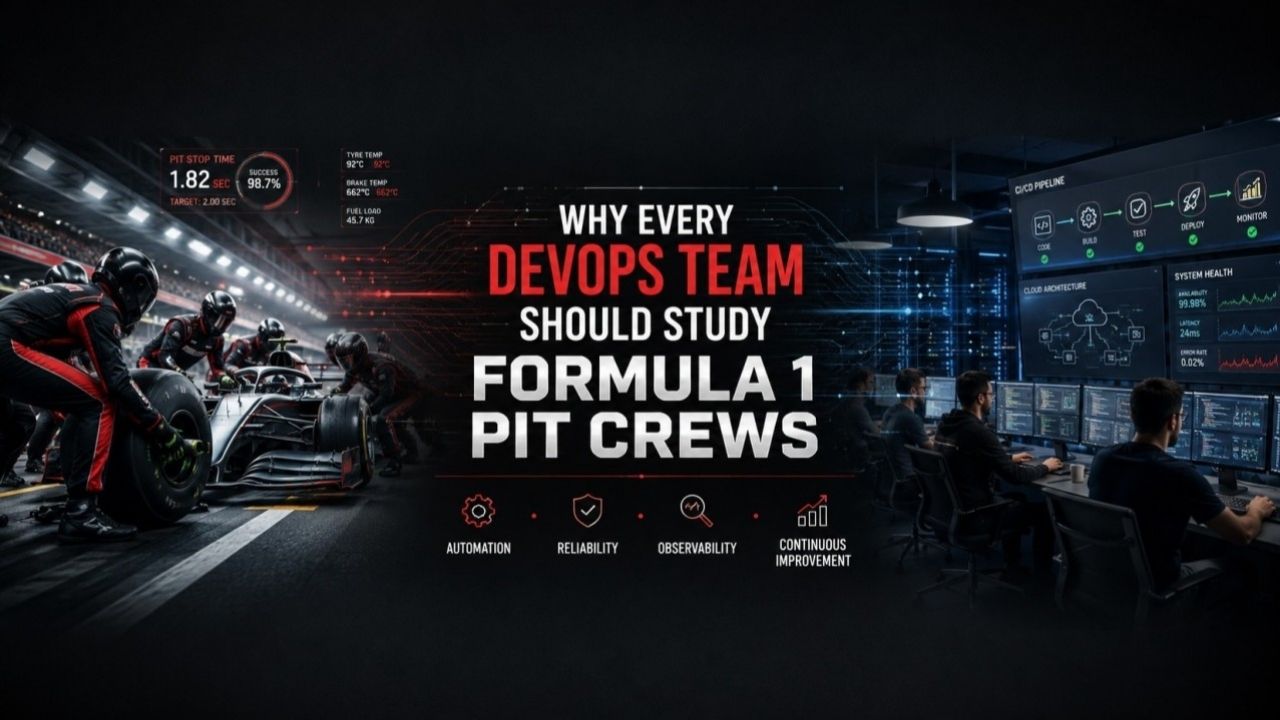
In other words, Formula 1 pit crews and high-performing DevOps teams have more in common than most people realize.
Why DevOps Teams Should Study Formula 1 Pit Crews
To the casual observer, a pit stop appears almost effortless.
What they don’t see are the hundreds of hours of preparation behind those two seconds.
Pit crews rehearse relentlessly. Every movement is documented, analyzed, refined, and repeated until it becomes muscle memory. Team members know exactly what is expected of them and exactly how their actions affect everyone around them.
Elite DevOps organizations operate the same way.
The fastest software deployments are rarely the result of last-minute heroics. They’re the result of carefully designed processes, automated workflows, testing frameworks, and teams that understand their roles.
The race is won long before the green flag drops.
Every Team Member Has a Critical Role
A Formula 1 pit stop is one of the clearest examples of specialized expertise working toward a common objective.
The wheel gun operator focuses on a single task. The tire carrier focuses on another. The jack operators have their own responsibilities. Each role is highly specialized, yet every action must occur in perfect synchronization.
DevOps teams face a similar challenge.
Platform engineers, cloud architects, security professionals, developers, site reliability engineers, and operations teams all bring specialized skills to the table. Individually, they may excel. Collectively, they must function as a single unit.
One person’s delay can impact the entire system. One missed step can create downtime, outages, or security vulnerabilities.
Success is rarely about individual brilliance. It’s about coordinated execution.
Automation Creates Consistency
Imagine if a Formula 1 pit crew had to make every decision manually during a race.
Performance would suffer immediately.
The best teams remove unnecessary variables wherever possible. Equipment is standardized. Procedures are documented. Processes are optimized to minimize human error.
The same principle has fueled the rise of DevOps.
Infrastructure as Code, CI/CD pipelines, automated testing, monitoring platforms, and deployment automation exist for a simple reason: consistency wins.
When organizations automate repetitive tasks, they reduce risk, improve reliability, and free talented people to focus on higher-value work.
Just as a pit crew relies on precision-engineered tools, DevOps teams rely on automation to deliver repeatable outcomes under pressure.
Failure Analysis Is Part of the Culture
Even the best Formula 1 teams make mistakes.
A wheel nut sticks. A tire change takes too long. A communication breakdown costs valuable seconds.
What separates championship-winning organizations from everyone else is how they respond.
Every mistake is reviewed, every process examined, every opportunity for improvement identified.
There is little interest in assigning blame. The focus is on learning.
Leading DevOps organizations embrace the same mindset. Post-incident reviews, retrospectives, and root cause analysis are designed to improve systems rather than punish individuals.
The objective isn’t perfection. The objective is continuous improvement.
Monitoring Matters
A Formula 1 team constantly monitors the health of the car. Engine temperatures. Tire degradation. Fuel consumption. Brake performance. Aerodynamic efficiency.
Engineers don’t wait for a catastrophic failure before taking action. They identify warning signs early and make adjustments before small issues become race-ending problems.
Modern DevOps teams do exactly the same thing.
Application performance monitoring, observability platforms, logging systems, and real-time alerts help organizations detect issues before customers feel the impact.
The goal is not simply to react faster. The goal is to prevent problems from occurring in the first place.
The Best Teams Thrive Under Pressure
Race day is not the time to figure things out. Neither is a production outage.
Both Formula 1 teams and DevOps organizations operate in environments where performance matters, stakes are high, and mistakes can be costly.
The teams that consistently outperform their competitors are not necessarily the ones with the biggest budgets or the most resources. They’re the teams that prepare relentlessly, communicate effectively, automate intelligently, and learn continuously.
Where Technology and Talent Intersect
One of the biggest challenges facing organizations today isn’t selecting the right cloud platform, automation tool, or monitoring solution. It’s finding the people capable of bringing those technologies together into a high-performing system.
The same way a Formula 1 team can’t succeed with world-class equipment and an inexperienced pit crew, organizations can’t fully realize the benefits of DevOps without the right talent in place.
Demand for DevOps Engineers, Site Reliability Engineers, Platform Engineers, Cloud Architects, Infrastructure Engineers, and DevSecOps professionals continues to outpace supply. The organizations that move fastest are often those that approach DevOps recruiting as a competitive advantage rather than simply a hiring requirement. That connection between talent strategy and delivery performance is something we get into in What Success in Hiring Actually Looks Like.
At recruitAbility, we work with companies building modern technology organizations, helping them identify and secure the specialized talent needed to accelerate delivery, improve reliability, and support long-term growth.
Whether you’re competing for a championship or market share, success ultimately comes down to having the right team in the pit lane.
Final Lap
Formula 1 pit stops may seem worlds away from cloud infrastructure and software delivery, but the underlying principles are remarkably similar.
Both require specialized talent, flawless coordination, and a commitment to automation. And both treat continuous improvement as a competitive advantage.
Most importantly, both understand that speed without reliability is meaningless.
Whether you’re changing four tires in two seconds or deploying software to millions of users, success comes from building systems, processes, and teams that can perform under pressure. For a closer look at what that actually requires on the hiring side, Recruiting Reimagined. And Why Right Now It Has Never Mattered More. is worth your time.
That’s a lesson every DevOps leader can appreciate.
Related Articles
What Success in Hiring Actually Looks Like
Recruiting Reimagined. And Why Right Now It Has Never Mattered More