
Recruiting Models FAQ: When to Use Internal, Contract, Embedded, and Managed Solutions
Recruiting models FAQ conversations usually start the same way. A role has been open longer than expected, the team feels the pressure, and the question becomes simple: what is the best way to hire right now? The problem is that most companies are not dealing with a single hiring decision. They are dealing with a system that is either holding up under demand or starting to break down.
That difference matters more than the model itself.
Internal recruiting, contract support, embedded recruiters, and managed solutions all have a place. The challenge is understanding when each one actually fits. Most companies do not struggle because they chose the wrong model once. They struggle because they keep using the same model after it stops working.
This article walks through the questions that come up when hiring starts to feel harder than it should and the recruiting model behind it no longer matches the reality of the business.
What are the different types of recruiting models and how do they actually differ?
Most recruiting models fall into four core categories, but the real difference is not in how they are labeled. It is in how they function under pressure.
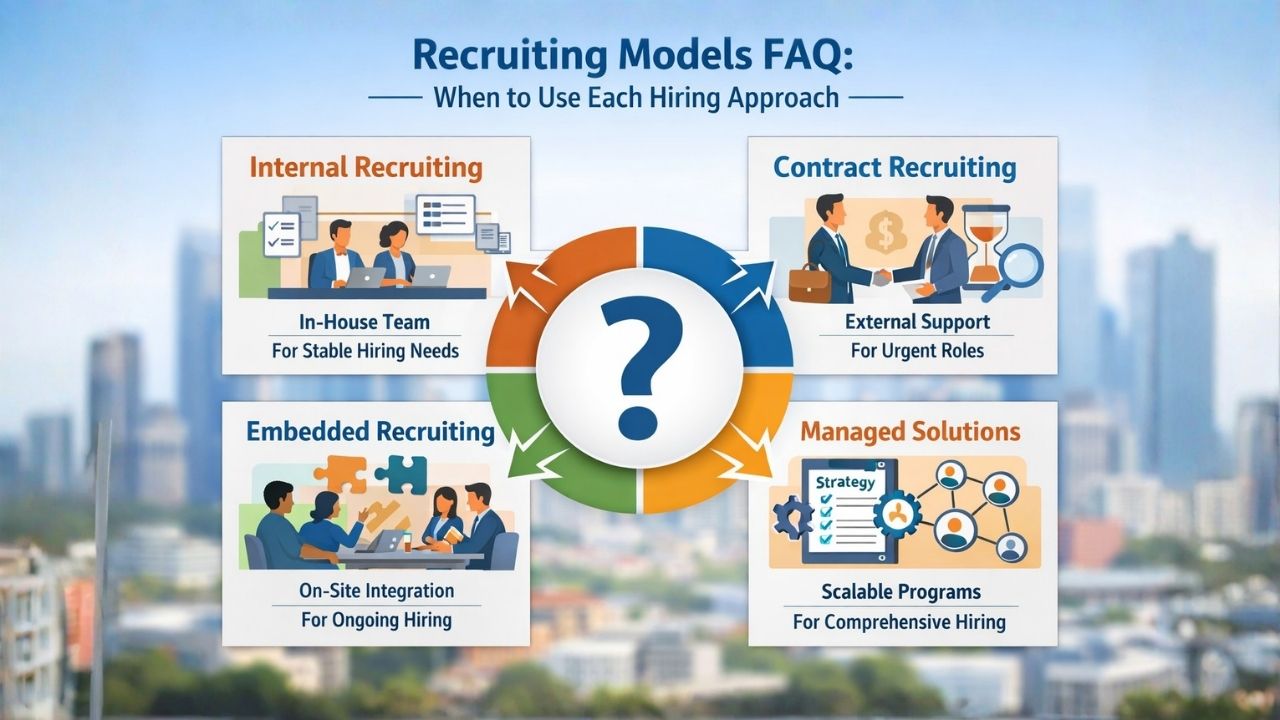
Internal recruiting is the starting point for most companies. It works well when hiring demand is predictable and the team has enough capacity to manage both execution and coordination. Recruiters are close to the business, understand the culture, and can align directly with hiring managers. When the workload is manageable, this model feels efficient and controlled.
Contract recruiting is more targeted. It is typically used when hiring demand spikes or when a specific role needs to be filled quickly. It adds flexibility without requiring a long-term commitment. The structure of the process usually stays the same, but additional resources are brought in to increase output.
Embedded recruiting takes a step further. Instead of operating from the outside, recruiting support is integrated directly into the team. This improves communication, reduces delays, and creates more consistency across searches. It is often used when hiring becomes ongoing rather than occasional.
Managed recruiting solutions bring a broader level of structure. They support not just individual searches, but the overall recruiting operation. This includes process consistency, workflow management, communication, and visibility across multiple roles.
The key difference is not which model sounds more advanced. It is which model aligns with the current stage of the business. That is why Choosing the Right Recruiting Model for Your Business becomes less about preference and more about fit.
When does internal recruiting stop being enough for a growing company?
Internal recruiting does not fail all at once. It stretches.
At first, the team absorbs the additional workload. Recruiters take on more roles. Hiring managers stay engaged. The process still works, but it starts to feel heavier. That weight shows up in small ways before it becomes obvious.
Roles take longer to fill. Communication requires more follow-up. Scheduling becomes harder to coordinate. Recruiters spend more time tracking progress than actually advancing searches. None of these signals feel urgent on their own, which is why they are easy to ignore.
Over time, they begin to stack.
The system becomes dependent on effort rather than structure. Internal teams work harder, but results do not improve at the same pace. That is usually the point where companies realize the issue is not capability. It is capacity combined with process limitations.
This is the same pattern outlined in When Internal Recruiting Hits Its Ceiling, where the model continues to function, but no longer performs at the level the business needs.
How is contract recruiting different from direct hire in real-world execution?
Contract recruiting and direct hire often get grouped together because they both involve external support, but they serve different purposes.
Contract recruiting is typically used to increase speed. It allows companies to bring in additional help to source and move candidates quickly without changing the overall structure of the hiring process. It is flexible and effective for immediate needs, especially when internal teams are stretched.
Direct hire focuses more on long-term placement. It is often used for clearly defined roles where the process is more structured and less dependent on rapid scaling. It can work well when hiring demand is controlled and expectations are stable.
The difference becomes more noticeable when hiring volume increases.
Contract recruiting adds capacity, but it does not necessarily improve how the process operates. Direct hire can be effective for individual roles, but it may not scale well across multiple teams at the same time. That is where companies start to feel the limitations of both models.
This is explored further in Contract Recruiting vs Direct Hire: What Actually Changes, where the impact on process and scalability becomes clearer.
When does embedded recruiting start to make more sense?
Embedded recruiting becomes relevant when hiring is no longer a series of isolated events. It becomes part of the daily operation.
Instead of bringing in support for one role at a time, companies integrate recruiting directly into their teams. This allows for closer alignment with hiring managers, faster communication, and more consistent execution across searches.
The value of embedded recruiting shows up in the details.
Feedback loops become shorter. Scheduling moves faster. Expectations are clearer. Recruiters are able to stay aligned with business priorities because they are working within the environment rather than outside of it.
This model is especially useful when hiring demand is steady and requires ongoing coordination rather than occasional support. It creates a level of consistency that is difficult to achieve through external, transactional models alone.
That is why When Embedded Recruiting Makes Sense often aligns with companies that have moved past reactive hiring and need something more integrated.
Why do one-size recruiting models fail as companies grow?
One-size recruiting models fail because hiring demand is not static.
A model that works at one stage of growth may not work at the next. Internal recruiting may be effective early on but struggle under higher volume. Contract recruiting may solve short-term needs but fail to provide long-term stability. Embedded recruiting may improve consistency but still require additional structure as complexity increases.
The issue is not the model itself. It is the assumption that it can handle every situation.
As companies grow, hiring becomes more complex. More stakeholders are involved. Roles become harder to define. Timelines become more critical. Trying to force one model to handle all of that creates inefficiency.
This is the pattern described in Why One-Size Recruiting Models Fail, where limitations become more visible as the business evolves.
How do you know when outside recruiting is actually worth it?
Outside recruiting becomes worth it when the cost of inefficiency starts to outweigh the cost of support.
That is not always obvious at first. The system may still be functioning. Roles are being filled. Candidates are entering the pipeline. On the surface, everything appears intact.
Beneath that surface, small issues begin to build.
Communication slows down. Feedback takes longer. Candidates lose interest. Hiring managers follow up more often. Recruiters spend more time managing the process than executing it.
These signals indicate that the system is under pressure.
At that point, outside recruiting does more than add capacity. It helps restore structure, improve coordination, and reduce strain on internal teams. The decision is not about replacing internal recruiting. It is about reinforcing the system so it can function effectively.
This is outlined in How to Decide When Outside Recruiting Is Worth It, where the focus shifts from effort to efficiency.
What is the real difference between recruiting support and ownership?
Recruiting support and ownership may look similar at a glance, but they operate very differently in practice.
Support involves contributing to specific parts of the process. This might include sourcing candidates, reviewing resumes, or assisting with screenings. It can increase activity, but it does not necessarily improve how the process is managed.
Ownership changes that dynamic.
It involves taking responsibility for driving the process forward. This includes coordination, communication, and accountability across all stages of hiring. Instead of multiple contributors managing separate pieces, there is a clear structure that keeps everything connected.
The difference matters because many hiring challenges are not caused by a lack of effort. They are caused by a lack of consistency and control.
Support adds effort. Ownership improves execution.
This distinction is explored in The Difference Between Recruiting Support and Ownership, where the impact on hiring outcomes becomes more clear.
When should a company consider managed recruiting solutions?
Managed recruiting solutions become relevant when hiring is no longer just a series of searches. It becomes an operational function that needs structure.
This is common in mid-market companies. Hiring demand increases, but internal teams are not large enough to manage everything consistently. The process becomes more complex, and the cost of inefficiency becomes more visible.
Managed solutions help address that complexity.
They create a more structured approach to recruiting, improve visibility across roles, and support both execution and coordination. Instead of reacting to hiring needs, companies are able to manage them more predictably.
This shift is explained in Why Mid-Market Companies Shift to Managed Solutions, where the need for a more stable recruiting model becomes clear.
How do recruiting models change as a company grows over time?
Recruiting models evolve as the business grows.
Early-stage companies often rely heavily on internal recruiting. Hiring is manageable, and the process is relatively simple. As demand increases, contract recruiting may be introduced to handle spikes. When hiring becomes more consistent, embedded recruiting can provide deeper support.
Eventually, companies may need to adopt a more structured approach.
Managed solutions often come into play at this stage. They help create a system that can support ongoing hiring without requiring the company to build a fully scaled internal team immediately.
Growth changes more than volume. It changes complexity, coordination, and expectations. Recruiting models need to evolve to match that.
Can companies use multiple recruiting models at the same time?
Most companies already do, whether they realize it or not.
Internal recruiting may handle core roles. Contract support may be used for urgent hires. Embedded or managed solutions may support ongoing demand. These models are not mutually exclusive.
The goal is not to simplify everything into one approach. It is to create a system that can handle different types of hiring needs without breaking down.
The challenge is coordination.
Without a clear structure, combining models can create confusion. With the right framework, it can create flexibility and stability at the same time.
How should a company decide which recruiting model to use overall?
The decision comes down to alignment.
Companies need to look at their current hiring demand, internal capacity, and process maturity. They need to understand where delays occur, how much coordination is required, and whether the current model supports consistent execution.
The right model is the one that fits the current stage of the business.
That decision is not permanent. Recruiting models should evolve as the company grows. What works today may not work next year.
The companies that get this right are the ones that treat recruiting as an operational function rather than a series of isolated tasks.
Related Articles
Choosing the Right Recruiting Model for Your Business
When Internal Recruiting Hits Its Ceiling
Contract Recruiting vs Direct Hire: What Actually Changes
When Embedded Recruiting Makes Sense