
Why One-Size Recruiting Models Fail
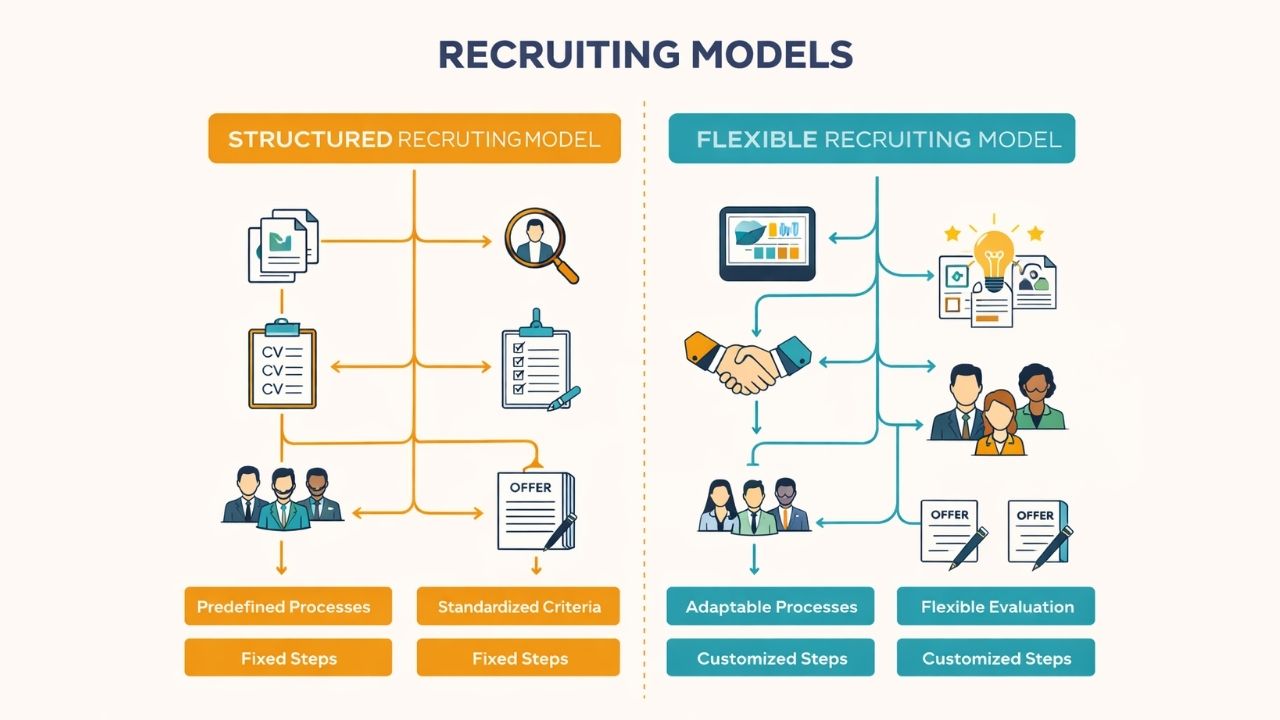
Recruiting models fail when they are treated as fixed solutions in an environment that is constantly changing. Hiring rarely stays predictable for long. A company may move from steady growth to rapid expansion in a single quarter. A team that was stable six months ago may suddenly need to scale. When that shift happens, a recruiting model that once worked well can start to feel slow, rigid, or out of sync with what the business actually needs.
Early on, most companies do not notice the shift. The process still functions. Roles are getting filled. Recruiters stay busy. Hiring managers remain engaged. From the outside, everything appears to be working. Underneath that surface, however, the cracks start to form. Timelines stretch slightly. Communication takes longer than it used to. Small inefficiencies begin to stack up.
Over time, those small issues become harder to ignore. Candidates start dropping out. Hiring managers begin asking more questions about progress. Recruiters spend more time managing the process than moving it forward. At that point, the issue is no longer about effort. The issue is that the structure itself no longer fits.
Why Familiar Recruiting Models Stick Around Too Long
Most recruiting models do not fail overnight. They fade slowly, which makes them harder to recognize as a problem.
A process that worked well in the past creates confidence. Teams trust what they know. Internal recruiters build routines around it. Hiring managers understand what to expect. Because of that familiarity, companies tend to stick with the same approach even as hiring conditions change.
That comfort can become a liability. When a recruiting model is repeated long enough, it becomes the default. Instead of evaluating whether it still fits, teams focus on executing it better. They refine steps, adjust timelines, and try to improve outcomes without questioning the foundation itself.
This is often where the first signs of strain appear. The process still exists, but it no longer performs at the same level. Teams work harder to maintain results that used to come more naturally. That shift is subtle at first, but it grows more obvious as hiring demand increases.
In many cases, this is the same stage described in When Internal Recruiting Hits Its Ceiling, where effort continues to rise but output starts to level off.
Where One-Size Recruiting Models Break First
The first breakdown usually happens when hiring demand becomes less predictable.
In a steady hiring environment, a single recruiting model can hold up. Roles are defined. Timelines are consistent. Workloads remain manageable. Under those conditions, even a rigid process can produce solid results.
Once variability increases, the same structure starts to struggle. Hiring needs may come from multiple departments at once. Roles may require different skill sets. Priorities may shift quickly based on business demands.
At that point, coordination becomes more complex than sourcing. Recruiters need to manage multiple timelines, stakeholders, and expectations simultaneously. A one-size model does not provide the flexibility required to handle that complexity.
Instead of adapting, teams often try to force the existing model to handle more. They increase workloads, compress timelines, and push for faster results. That approach usually creates more friction instead of solving the problem.
Why Different Roles Require Different Approaches
Not all roles are created equal, and treating them as if they are leads to inconsistent results.
Some positions are clearly defined with straightforward requirements. Others are more nuanced, requiring a deeper understanding of both skill set and cultural alignment. Leadership roles often involve a completely different level of evaluation compared to mid-level or high-volume hiring.
When companies apply the same recruiting model to every role, they ignore those differences. As a result, some roles get over-served while others get under-supported.
For example, a direct hire approach may work well for a specialized leadership role where depth matters more than speed. That same approach may struggle in a high-volume hiring scenario where efficiency and consistency are more important.
Understanding the distinction outlined in Contract Recruiting vs Direct Hire: What Actually Changes helps clarify why one model cannot effectively cover every situation.
How Misalignment Creates Hidden Delays
Misalignment between the recruiting model and the hiring need does not always show up as an obvious failure. More often, it appears as a series of small delays.
Recruiters spend extra time clarifying requirements. Hiring managers revisit decisions that should already be settled. Candidates wait longer between steps without clear updates.
Individually, those delays may seem minor. Collectively, they slow down the entire process.
As the process slows, candidate experience begins to decline. Strong candidates have more options, and they tend to move toward opportunities that feel more organized and responsive. That leaves companies with fewer choices and longer timelines.
This is not a sourcing issue. It is a structural issue. The model is not aligned with the demands of the search.
Why More Effort Does Not Fix the Problem
When hiring starts to slow down, the instinct is to push harder.
Recruiters take on more roles. Hiring managers increase their involvement. Teams try to accelerate timelines. At first glance, that approach feels productive. In reality, it often creates more pressure without improving outcomes.
More effort cannot fix a misaligned system. It only amplifies the weaknesses already present.
Recruiters become stretched too thin to maintain consistency. Hiring managers become frustrated with the lack of progress. Candidates experience a process that feels rushed in some areas and delayed in others.
Over time, that imbalance makes hiring less predictable. The process becomes reactive instead of structured. Teams spend more time solving problems than preventing them.
Why Flexibility Becomes a Competitive Advantage
Companies that adapt their recruiting approach based on hiring needs tend to outperform those that rely on a single model.
Flexibility allows teams to respond to changes without disrupting the process. When hiring demand increases, additional support can be added. When roles become more specialized, the approach can shift to match the complexity.
That adaptability reduces friction. It allows recruiters to focus on execution rather than constant adjustment. Hiring managers gain confidence in the process because it remains consistent even as conditions change.
The difference becomes especially clear when comparing fixed approaches to more adaptive ones, as explored in Choosing the Right Recruiting Model for Your Business.
What Strong Hiring Systems Do Differently
Strong hiring systems are built with variability in mind. They do not assume that hiring conditions will remain the same.
Instead of relying on one model, they use a combination of approaches to support different needs. Internal recruiting handles core responsibilities. External support fills gaps when needed. Embedded recruiting provides structure when hiring demand becomes ongoing.
Because of that balance, the system remains stable even as hiring demands shift. Teams can scale up or down without losing momentum.
This approach also prevents the larger breakdowns described in The Hiring System is Breaking – And Everyone Knows It, where outdated structures struggle to keep pace with modern hiring expectations.
How to Recognize When Your Model Is No Longer Working
Recognizing when a recruiting model no longer fits is not always straightforward. The signs tend to appear gradually.
Hiring timelines begin to extend without a clear reason. Communication becomes less consistent across stakeholders. Recruiters spend more time coordinating than executing. Hiring managers begin asking for updates more frequently.
As those patterns continue, the process starts to feel heavier. What once felt manageable now requires significantly more effort to maintain.
Paying attention to these signals early allows companies to adjust before the process fully breaks down.
The Real Cost of Using the Wrong Model
The cost of a misaligned recruiting model goes beyond delayed hires.
Open roles reduce team productivity. Existing employees take on additional work, which can lead to burnout. Projects move slower than planned. Business growth becomes harder to sustain.
According to the Society for Human Resource Management, the cost of a bad hire can reach up to 50 to 60 percent of an employee’s annual salary. That does not account for the additional impact of extended vacancies or lost opportunities.
When the recruiting model does not fit, those costs increase. Delays become more frequent. Candidate quality may decline. Internal teams spend more time compensating for gaps.
What Works Instead of One-Size Models
A more effective approach treats recruiting models as tools rather than fixed strategies.
Each model serves a purpose. Direct hire supports defined roles. Contract recruiting adds flexibility and capacity. Embedded recruiting provides structure for ongoing hiring demand.
Using these models together allows companies to adapt without disrupting the process. Instead of forcing one approach to solve every problem, teams can choose the model that fits the situation.
That shift creates a more balanced system. Hiring becomes more predictable. Timelines improve. Candidate experience strengthens.
Why One-Size Recruiting Models Continue to Fail
At their core, one-size recruiting models fail because they assume stability in an environment that rarely provides it.
Hiring needs change. Business priorities evolve. Teams grow and shift over time. A fixed approach cannot adapt to those changes without creating friction.
Understanding that reality allows companies to move toward more flexible systems. When the recruiting model aligns with the hiring need, the process becomes more efficient and more effective.
That alignment is what ultimately separates companies that struggle with hiring from those that maintain consistent momentum.
Related Articles
When Internal Recruiting Hits Its Ceiling
Contract Recruiting vs Direct Hire: What Actually Changes
When Embedded Recruiting Makes Sense
The Hiring System is Breaking – And Everyone Knows It
Recruiting Models FAQ: When to Use Internal, Contract, Embedded, and Managed Solutions