
Why Some Hiring Problems Never Get Solved Internally
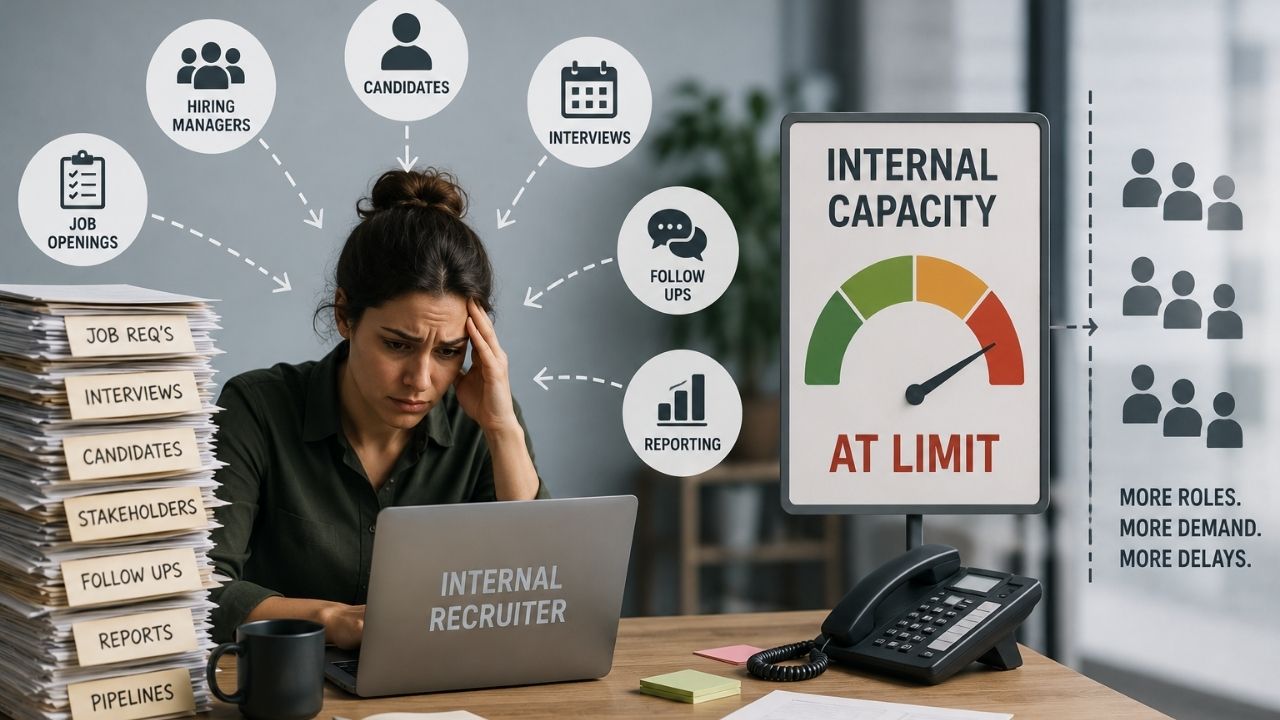
Most organizations believe hiring problems can eventually be solved internally.
At first, that assumption feels reasonable. Internal recruiting teams understand the business, know the culture, and work closely with hiring managers every day. When hiring slows, the natural response is usually to adjust workloads, add recruiters, improve sourcing activity, or refine the process internally.
Sometimes those adjustments help.
However, some hiring problems continue resurfacing no matter how much internal effort increases.
Roles stay open too long. Candidate quality remains inconsistent. Hiring managers lose confidence in pipelines. Recruiters become overloaded with coordination work instead of strategic execution.
Over time, organizations begin experiencing the same hiring breakdowns repeatedly.
This is where many teams reach a difficult realization. The issue is no longer recruiter effort, sourcing activity, or temporary market conditions.
The issue is that the hiring system itself has reached its operational limits.
Some hiring problems never get solved internally because the recruiting model no longer fits the complexity of the organization.
Why internal recruiting systems eventually hit operational ceilings
Internal recruiting systems are usually built around stability.
At smaller scale or during moderate growth periods, this works well. Recruiters build strong relationships with hiring managers, communication remains relatively direct, and decision-making stays manageable.
Initially, flexibility becomes a strength.
However, complexity increases faster than most organizations expect.
As businesses grow, hiring expands across departments, locations, leadership levels, and specialized functions simultaneously. Recruiters begin managing competing priorities across teams with very different expectations.
This is where operational ceilings begin appearing.
At first, the signs feel manageable. Feedback slows slightly. Recruiters spend more time coordinating interviews. Stakeholders begin revisiting decisions more frequently.
Over time, those inefficiencies compound across the system.
Recruiters become increasingly reactive. Hiring managers compete for attention. Candidate experiences become inconsistent across departments.
Eventually, the internal recruiting structure itself becomes the limiting factor.
This transition is explored further in When Internal Recruiting Hits Its Ceiling, where hiring complexity begins overwhelming systems originally designed for much simpler environments.
Why more internal effort does not always improve hiring outcomes
When internal hiring systems begin slowing down, organizations usually respond by increasing effort.
Recruiters work longer hours. Teams increase sourcing activity. Hiring managers request larger pipelines. Additional coordination meetings are added to improve alignment.
Initially, this creates the appearance of momentum.
However, effort alone cannot fix structural limitations.
If ownership remains fragmented, communication inconsistent, or decision-making unstable, additional effort often increases complexity instead of improving outcomes.
This is one reason hiring systems can feel extremely active while very little actual progress happens, a challenge explored further in When Hiring Feels Busy but Nothing Moves Forward.
Eventually, internal teams spend more energy maintaining activity than improving hiring effectiveness.
Why internal recruiting teams struggle with specialized searches
Specialized searches expose internal recruiting limitations quickly.
Most internal recruiting systems are optimized for repeatability and operational consistency. They work best when role requirements remain relatively stable and hiring workflows stay predictable.
Specialized hiring environments operate differently.
Leadership roles, niche technical positions, and highly competitive talent markets require deeper alignment, targeted outreach, and stronger process ownership throughout the search.
These searches also involve higher uncertainty.
Hiring managers often refine expectations mid-process. Stakeholders evaluate candidates differently. Candidate pools remain smaller and more relationship-driven.
Without highly structured ownership and coordination, specialized searches become difficult to sustain internally.
Over time, recruiters spend more time recalibrating expectations than driving execution.
This is one reason organizations frequently experience repeated breakdowns during high-complexity searches even when internal recruiting teams remain highly capable.
Scenario: Internal recruiting absorbs too much complexity
A growing organization expands hiring across multiple departments while simultaneously opening several leadership searches.
Initially, the internal recruiting team absorbs the additional workload successfully. Recruiters prioritize aggressively, communication remains relatively stable, and leadership feels confident in the process.
However, complexity increases rapidly.
Operational hiring continues expanding while leadership searches require deeper stakeholder alignment and longer evaluation cycles. Recruiters begin managing conflicting priorities across multiple business units.
At first, the issue appears to be bandwidth.
Additional sourcing activity is introduced. Recruiters increase candidate outreach. Hiring managers request larger pipelines.
Despite increased effort, hiring outcomes continue slowing.
Recruiters spend more time managing process instability than driving searches forward. Candidate communication becomes inconsistent. Hiring managers lose confidence in progress visibility.
Eventually, leadership realizes the issue is not recruiter capability.
The issue is that the recruiting model itself no longer supports the level of organizational complexity.
Why internal hiring systems become reactive over time
Reactive hiring systems rarely develop intentionally.
Most organizations begin with relatively effective recruiting structures. However, as growth accelerates and hiring complexity increases, teams gradually shift from proactive planning toward constant reaction.
Urgent hiring requests interrupt existing priorities. Stakeholders redefine roles during active searches. Recruiters adjust processes repeatedly to accommodate shifting expectations.
Over time, stability disappears.
This creates an environment where recruiters spend most of their time responding to operational friction instead of building long-term hiring momentum.
As a result, the organization continues hiring, but the process itself becomes increasingly difficult to sustain internally.
Why ownership fragmentation prevents internal resolution
Ownership fragmentation is one of the biggest reasons some hiring problems remain unsolved internally.
When accountability spreads across too many stakeholders, alignment weakens quickly.
Recruiters assume hiring managers will drive decisions. Hiring managers expect recruiters to maintain momentum. Leadership expects visibility without directly resolving process instability.
As responsibility becomes distributed, decision-making slows dramatically.
This creates repeated bottlenecks throughout the hiring process.
Candidates wait longer between interviews. Recruiters revisit the same alignment conversations repeatedly. Hiring managers lose confidence because priorities continue shifting across stakeholders.
Over time, the organization adapts to dysfunction instead of resolving it.
This distinction between support and accountability is explored further in Why Hiring Ownership Matters More Than Hiring Support.
Why hiring model misfit creates recurring problems
Many recurring hiring problems are actually recruiting model problems.
Organizations continue operating within recruiting structures designed for smaller scale, lower complexity, or more stable hiring environments even after business conditions change significantly.
At first, those systems appear functional because activity continues.
However, recurring breakdowns begin appearing across multiple searches.
Leadership searches stall repeatedly. Specialized roles remain open too long. Hiring managers lose confidence in recruiting timelines. Candidate disengagement increases.
Eventually, organizations recognize that the issue is not isolated execution failure.
The recruiting model itself no longer matches the operational demands of the business.
This hidden structural problem is explored further in The Hidden Cost of Misaligned Recruiting Models.
Scenario: Hiring managers lose confidence in internal recruiting
An organization experiences repeated delays across several important searches.
Recruiters continue building pipelines and scheduling interviews. However, hiring managers grow increasingly frustrated because roles continue remaining open longer than expected.
Leadership begins questioning candidate quality. Recruiters respond by increasing sourcing activity and expanding outreach efforts.
At first, this appears productive.
However, the underlying process instability remains unresolved. Decision-making stays inconsistent. Stakeholders continue redefining expectations during active searches.
Eventually, hiring managers stop trusting recruiting timelines entirely.
The issue is no longer candidate supply or recruiter effort. The issue is that the internal hiring system itself lacks the structure required to manage hiring complexity consistently.
Why structured external models solve problems internal systems cannot
Structured external recruiting models solve problems differently because they introduce operational accountability around the hiring process itself.
This is not simply about adding more recruiters.
The difference is structural.
Ownership becomes clearer. Coordination improves across stakeholders. Communication remains more consistent across searches and business units.
External recruiting structures also reduce internal process fragmentation because alignment responsibilities become centralized instead of distributed informally across teams.
As a result, organizations regain visibility, momentum, and consistency across hiring systems that previously felt reactive and unstable.
This is one reason many growing organizations eventually shift toward more coordinated recruiting structures, a transition explored further in Why Mid-Market Companies Shift to Managed Solutions.
Organizations evaluating different recruiting structures often struggle to determine when direct hire, contract recruiting, or managed recruiting actually make the most sense. This Direct Hire vs Contract vs Managed Recruiting decision guide –> Direct-vs-Contract-vs-MRS.pdf provides a simple breakdown of where each model works best and where teams commonly run into problems.
Why internal recruiting limitations are often misdiagnosed
Organizations frequently misdiagnose internal recruiting limitations as temporary hiring market problems.
Leadership assumes talent shortages are causing delays. Recruiters are asked to increase activity. Hiring managers push for faster pipelines and larger candidate pools.
Meanwhile, the real issue remains operational.
The internal recruiting model no longer aligns with the organization’s hiring complexity, stakeholder structure, or growth environment.
Because the system still appears active, organizations often continue operating inside the same limitations for far too long.
As a result, recurring hiring problems become normalized internally.
What actually solves hiring problems that internal systems cannot fix
Organizations solve recurring hiring problems when they stop treating hiring slowdowns as isolated execution issues and begin evaluating whether the recruiting model itself still fits the business.
In practice, this starts with operational clarity. Ownership, communication, and decision-making accountability need to remain consistent across searches and stakeholders. Without that structure, complexity compounds faster than recruiters can stabilize the system internally.
Alignment also becomes critical. Hiring expectations, evaluation standards, and recruiting workflows need to stay coordinated across departments and leadership teams. Otherwise, recruiters spend too much time reacting to instability instead of executing strategically.
A scalable recruiting model creates consistency around those operational demands. It improves visibility, accountability, and coordination so hiring systems can continue functioning effectively as organizational complexity increases.
When those systems align, hiring becomes more predictable, more sustainable, and significantly easier to scale over time.
The bottom line on hiring problems that never get solved internally
Some hiring problems persist internally because the recruiting model itself has reached its operational limits.
At first, organizations respond by increasing effort. Recruiters work harder, sourcing expands, and processes become more reactive in an attempt to maintain momentum.
However, effort alone cannot solve structural misalignment.
As complexity increases, fragmented ownership, inconsistent communication, and unstable decision-making begin slowing the entire hiring system.
Organizations that recognize these patterns early stop focusing only on recruiting activity. Instead, they evaluate whether the operating model behind the hiring process still supports the scale and complexity of the business.
When the recruiting structure aligns with organizational reality, hiring becomes more coordinated, more scalable, and far more effective over time.
Related Articles
Choosing the Right Recruiting Model for Your Business
When Internal Recruiting Hits Its Ceiling
The Hidden Cost of Misaligned Recruiting Models
Why Hiring Ownership Matters More Than Hiring Support
Why Hiring at Scale Requires a Different Operating Model
When Hiring Feels Busy but Nothing Moves Forward