
How to Prepare for an Interview: What Recruiters Want You to Know
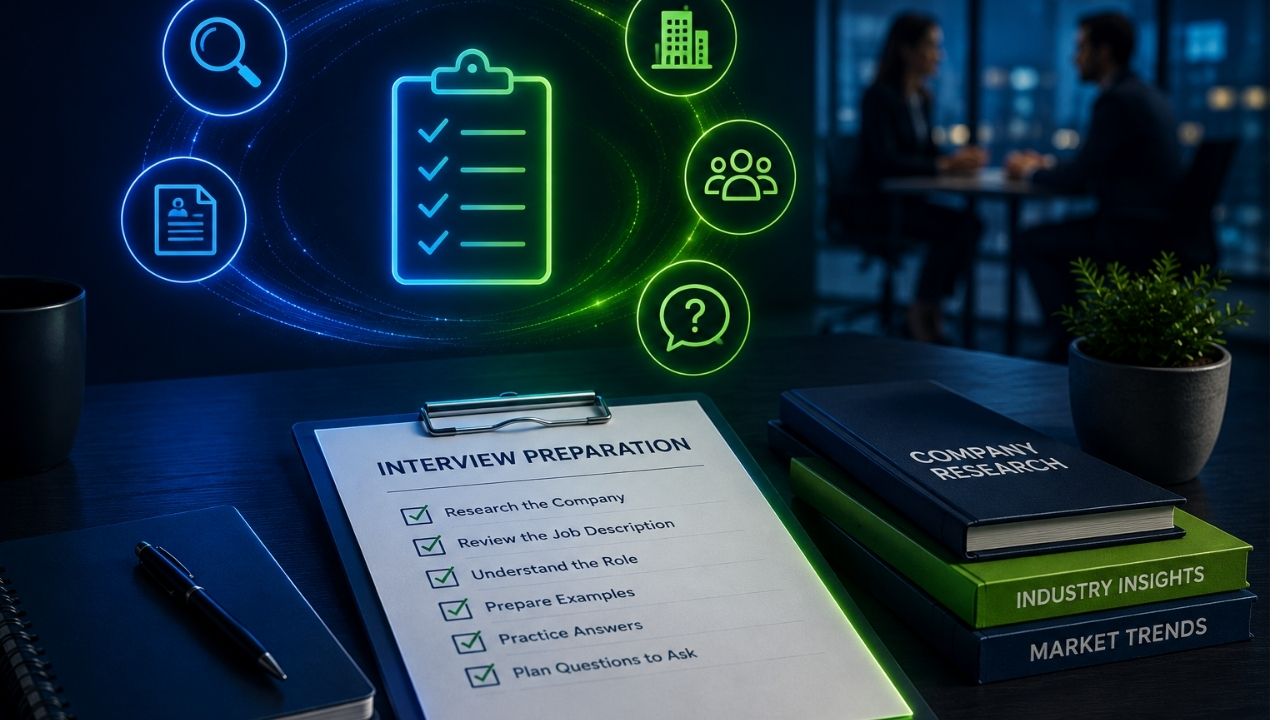
It begins the moment you decide that this is an opportunity worth pursuing.
Many candidates think interview preparation means reviewing a few common questions the night before or spending ten minutes on a company’s website. While those things can help, they rarely separate one qualified candidate from another. Hiring managers interview people with similar backgrounds every day. What often stands out is not who memorized the best answers. It’s who clearly understands the company, communicates their experience with confidence, and demonstrates genuine interest in the role.
The strongest interviews feel like conversations instead of interrogations. That doesn’t happen by accident. It happens because the candidate has already done the work before the interview begins.
Whether you’re interviewing for your first professional position or your next leadership role, thoughtful preparation allows you to spend less time searching for the right words and more time building a connection with the people across the table.
If you’re looking for a broader overview of today’s hiring process, start with our Complete Interview Guide for Today’s Hiring Process. This article focuses specifically on the preparation that happens before the interview and the steps that can help you walk into the conversation with confidence.
Why Interview Preparation Makes a Difference
Every interview is an opportunity to answer one question.
Can this person succeed here?
Everything you do before the interview helps the employer answer that question.
Preparation influences how confidently you speak about your experience, how naturally you respond to unexpected questions, and how well you connect your background to the company’s needs. It also affects something candidates often overlook: your ability to ask thoughtful questions and engage in a genuine conversation rather than simply responding to prompts.
Interviewers notice when candidates have invested time in understanding the business. They notice when someone can explain why they are interested in the role beyond wanting a new job. They also notice when answers feel rushed, generic, or disconnected from the position being discussed.
Preparation doesn’t guarantee you’ll receive an offer.
It does ensure that the interviewer is evaluating your experience instead of your lack of preparation.
For many candidates, that’s the difference between leaving an interview wondering what went wrong and leaving confident that they represented themselves well.
Start With the Job Description
Most candidates read the job description once before submitting their application and never look at it again.
That is a missed opportunity.
The job description tells you what the employer believes is most important about the role. It highlights the responsibilities, technical skills, leadership expectations, and business priorities they want to discuss during the interview. Reviewing it again before your interview helps you understand where to focus your preparation.
As you read through the posting, compare each major responsibility with your own experience. Think about projects you’ve completed, challenges you’ve solved, improvements you’ve made, and results you’ve delivered that relate directly to what the employer is looking for.
This isn’t about trying to force every answer back to the job description. Instead, it’s about recognizing where your experience naturally aligns with the position so those examples come to mind more easily during the conversation.
The goal is to help the interviewer see the connection between your background and the work they need someone to do.
What Recruiters Are Looking For
Recruiters aren’t expecting candidates to have done every task listed in a job description. They’re looking for evidence that your experience prepares you to succeed in the role. Candidates who understand which parts of their background are most relevant make that evaluation much easier for everyone involved.
Research the Company Like Someone Who Wants to Work There
One of the quickest ways to stand out in an interview is surprisingly simple.
Know who you’re interviewing with.
That doesn’t mean memorizing the company’s mission statement or reciting facts from its website. Most candidates can do that in a few minutes. Meaningful interview preparation goes further by helping you understand how the business operates, what challenges it may be facing, and why the role exists in the first place.
Start with the company’s website, but don’t stop there. Read recent news articles, browse its LinkedIn page, look at recent announcements, and pay attention to growth, acquisitions, new products, or leadership changes. If it’s a public company, reviewing recent earnings reports or investor presentations can also provide valuable context. For smaller organizations, local business news, press releases, and customer reviews often reveal useful insights.
As you learn more about the company, think about how your experience could contribute to its goals. The strongest candidates don’t try to impress interviewers with random facts. They use what they’ve learned to ask better questions, provide more relevant examples, and demonstrate genuine interest in becoming part of the organization.
Interviewers can usually tell the difference between someone who wants a job and someone who wants this job.
That distinction often begins with preparation.
Review Your Resume Through an Interviewer’s Eyes
By the time you reach the interview, your resume has already done its first job.
It convinced someone that you were worth talking to.
Now it serves a different purpose.
Throughout the interview, hiring managers and recruiters will use your resume as a roadmap for the conversation. Nearly every question they ask will connect back to something you’ve written, whether it’s a recent promotion, a career transition, a technical skill, or a project that caught their attention.
That means your interview preparation should include reviewing your own resume just as carefully as the interviewer will.
Read every section from top to bottom. Ask yourself where someone unfamiliar with your background might have questions. Are there accomplishments that deserve more explanation? Are there promotions that happened quickly? Did you change industries or employers several times? Is there a gap in employment that you’ll need to address?
None of these situations are necessarily negative. In many cases, they’re simply opportunities to provide additional context. The mistake candidates make is assuming they’ll think of that context during the interview instead of preparing it beforehand.
It’s equally important to make sure you can speak comfortably about every accomplishment you’ve included. If your resume says you improved efficiency by 30 percent, be prepared to explain how that happened. If you mention leading a major initiative, expect questions about your role, the challenges you encountered, and the results your team achieved.
The interview shouldn’t be the first time you’ve reflected on the stories behind the bullet points.
What Recruiters Are Looking For
Recruiters aren’t trying to catch candidates exaggerating their experience. They’re looking for consistency. Your resume, your LinkedIn profile, and your interview should all tell the same professional story. When those pieces align naturally, it builds confidence in everything else you share.
Prepare Experiences Instead of Memorizing Answers
One of the most common interview preparation mistakes is trying to predict every question that might be asked.
Candidates search for lists of the “Top 50 Interview Questions,” write detailed responses, and spend hours memorizing exactly what they want to say.
Unfortunately, interviews rarely follow the script you prepared.
Even when a familiar question comes up, a memorized answer often sounds exactly that way. Candidates become so focused on remembering the next sentence that they stop listening to the interviewer or adapting their response to the conversation.
A better approach is to prepare experiences rather than answers.
Think back through your career and identify the moments that best demonstrate your abilities. Consider projects that challenged you, difficult decisions you made, conflicts you resolved, goals you exceeded, improvements you introduced, and situations where you learned something valuable from a setback.
These experiences become the foundation for answering dozens of different interview questions because they’re real. A story about leading a cross-functional project, for example, might demonstrate leadership, communication, problem solving, conflict resolution, and adaptability depending on what the interviewer asks.
Preparing this way also allows your personality to come through. Instead of trying to remember a perfect response, you’re simply describing something you’ve actually experienced.
If you’re interviewing for roles that rely heavily on behavioral questions, our article How to Answer Behavioral Interview Questions explains how to organize these experiences into clear, compelling answers while keeping them conversational.
What Recruiters Are Looking For
Strong interview answers sound authentic because they’re built on real experiences. Interviewers remember candidates who can explain what happened, why they made certain decisions, what they learned, and how the outcome affected the business. Those conversations are far more memorable than perfectly rehearsed responses.
Learn About the People You’ll Be Meeting
Many candidates spend time researching the company but forget there’s another source of valuable information available before the interview.
The interviewers themselves.
If you know who you’ll be meeting, take a few minutes to review their LinkedIn profiles or read their biographies on the company’s website. Understanding someone’s role helps you anticipate the perspective they’ll bring to the conversation.
A recruiter may focus on your overall background and interest in the opportunity. A hiring manager will likely spend more time discussing your day-to-day responsibilities and technical experience. An executive may be more interested in how you think, solve problems, and contribute to long-term business goals.
Knowing who you’re speaking with isn’t about finding personal details or trying to impress them by mentioning something from their profile. Instead, it helps you understand why they’re in the interview and what they’re trying to evaluate.
That context makes it easier to tailor your examples, ask relevant questions, and have a more natural conversation.
It also reminds you that every interviewer views the hiring decision through a slightly different lens. Understanding those perspectives allows you to prepare more effectively without changing who you are.
Prepare Questions That Help You Evaluate the Opportunity
Nearly every interview ends with the same question.
“Do you have any questions for us?”
Candidates sometimes view this as a formality or an opportunity to ask about salary, benefits, or vacation time. While those conversations are important later in the hiring process, the interview is your chance to learn whether this is an organization where you can succeed.
The questions you ask demonstrate how you’re thinking about the opportunity. They also help you move beyond the job description and understand what the role actually looks like day to day.
Instead of asking questions that can be answered by reading the company’s website, focus on topics that only the people in the room can answer. Ask how success is measured, what challenges the person stepping into the role will inherit, what the team is working toward over the next year, or what separates employees who perform well from those who struggle.
These conversations often provide insights that no job posting ever could.
Just as importantly, they help you decide whether the position aligns with your own career goals. Interviews are designed to evaluate candidates, but they should also help candidates evaluate employers.
If you’d like additional ideas, our article Questions Candidates Should Ask During an Interview explores the types of questions that lead to more productive conversations and better hiring decisions.
Eliminate the Small Things That Create Big Distractions
Some interview mistakes have nothing to do with qualifications.
They’re the result of avoidable distractions that pull your attention away from the conversation.
For an in-person interview, that might mean leaving too late, getting lost on the way to the office, or arriving flustered because parking took longer than expected. For a virtual interview, it could be discovering your microphone isn’t working, your laptop needs an update, or your internet connection becomes unstable just as the interview begins.
None of these situations define your ability to do the job, but they can affect the first impression you make and increase your own stress before the interview has even started.
Taking a few minutes to prepare the logistics allows you to focus on what actually matters.
Confirm the interview time and location, allow extra travel time, and know where you’re going before you leave home. If the interview is virtual, test your camera, microphone, internet connection, and meeting link well in advance. Choose a quiet location where you can speak comfortably without interruptions, and make sure your surroundings are professional without becoming distracting.
Preparation isn’t only about what you’ll say.
It’s also about removing the obstacles that could prevent you from saying it well.
What Recruiters Are Looking For
Recruiters understand that unexpected things happen. A delayed flight, traffic accident, or internet outage can affect anyone. What stands out is how candidates respond. Communicating early, remaining professional, and adapting calmly often leaves a stronger impression than pretending nothing happened.
Prepare Yourself, Not Just Your Answers
The final hours before an interview should be about building confidence, not cramming information.
By the night before, your research should already be complete. Your resume should already be familiar. Your accomplishments should already be organized. Trying to learn everything at the last minute usually creates more anxiety than confidence.
Instead, spend a little time reviewing your notes, thinking through the examples you want to discuss, and reminding yourself why you’re interested in the opportunity. Make sure you have everything you’ll need for the interview, get a good night’s sleep, and give yourself enough time the next day so you aren’t rushing.
On the day of the interview, remember that your goal isn’t to deliver perfect answers.
It’s to have a thoughtful conversation about your experience, your accomplishments, and the value you can bring to the organization.
Listen carefully before responding. If you need a moment to think, take it. A brief pause often leads to a stronger answer than speaking immediately just to fill the silence.
Candidates sometimes assume confidence means having an answer for every question.
In reality, confidence usually comes from knowing you’ve prepared well enough to handle whatever direction the conversation takes.
Preparation Builds Better Interviews
Interview preparation isn’t about creating a polished performance or memorizing the “right” answers. It’s about putting yourself in the best position to have an honest, thoughtful conversation about your experience and the opportunity in front of you.
The strongest candidates aren’t always the ones with the longest resumes or the most impressive titles. They’re often the ones who understand the company, know how their experience relates to the role, and communicate that connection with confidence.
Every interview is a chance to demonstrate more than your qualifications. It’s an opportunity to show how you think, how you prepare, and how you approach new challenges.
When you’ve invested the time to prepare, you can spend less energy worrying about what to say next and more energy building the kind of conversation that hiring managers remember.
Related Resources