
The Strategic Hiring Framework: Ultimate Guide to Interviewing Candidates
Open positions are expensive. Most leaders feel the impact long before they see it on a financial report. Projects move slower, managers spend more time covering gaps, and existing team members absorb additional responsibilities while critical work waits to be completed. When hiring drags on, productivity suffers. When the wrong person is hired, the cost can be even greater.
Most organizations focus on compensation when calculating hiring costs, but salary is only one piece of the equation. Lost productivity, onboarding expenses, team disruption, delayed initiatives, and replacement costs can quickly multiply the true impact. The Hidden Cost of a Bad Hire Beyond Salary explores the business consequences in greater detail.
The challenge is that most hiring teams do not struggle because they lack effort. They struggle because they lack consistency. Different interviewers evaluate different things. One person focuses on technical skills. Another evaluates communication style. Someone else makes a decision based largely on instinct. By the end of the process, the team may have spent hours interviewing candidates without a clear framework for comparing them.
The strongest hiring organizations approach interviews differently. They create a process designed to gather meaningful information and evaluate candidates against consistent criteria. That is where a strategic hiring framework becomes valuable. When interviewers know what they are looking for and how they plan to evaluate it, hiring decisions become more objective, more repeatable, and ultimately more successful.

The 70/30 Secret to Effective Interviews
What is the 70/30 rule in hiring?
The 70/30 rule suggests that interviewers should spend approximately 30% of the interview talking and 70% listening. While simple in theory, many interviews operate in reverse. Hiring managers spend significant time explaining the company, describing the role, discussing team dynamics, and answering questions before learning much about the candidate sitting across from them.
The purpose of an interview is not simply to present an opportunity. The purpose is to gather information. Candidates reveal their experience, judgment, problem-solving ability, communication style, and leadership potential when they have room to talk about real situations they have encountered throughout their careers.
Organizations that consistently make strong hires understand that the best interviews are rarely dominated by the interviewer. Instead, they create space for candidates to explain what they have done, why they made certain decisions, what challenges they encountered, and what results they achieved. The more meaningful information an interviewer collects, the easier it becomes to evaluate whether someone can succeed in the role.
Gathering better information early in the process also helps hiring teams identify concerns before they reach the offer stage. Many late-stage hiring surprises can be traced back to gaps in qualification, expectations, or communication during the interview process. How Do You Improve Your Offer Acceptance Rates? explores how strong interviewing and expectation alignment can dramatically improve closing success.
Listening Your Way to a Better Hire
Listening sounds easy, but it is often one of the most overlooked skills in interviewing.
Many interviewers focus so heavily on their next question that they miss opportunities to explore the candidate’s answers. A strong interviewer approaches conversations with curiosity. Instead of rushing through a list of questions, they listen for details worth exploring further.
For example, a candidate may mention leading a struggling project back to success. An average interviewer moves to the next question. A strong interviewer asks what caused the project to struggle, how the candidate built consensus, what obstacles emerged, and what lessons were learned. Those follow-up questions often reveal more than the original answer.
This approach also improves the candidate experience. Most professionals appreciate interviews that feel like conversations rather than interrogations. Candidates have an opportunity to share their experiences in greater detail while interviewers gather richer information. Both sides leave the discussion with a clearer understanding of whether the opportunity is the right fit.
The best interviewers often ask fewer questions than expected because they spend more time exploring the answers they receive.
Behavioral Prompts That Force Candidates to Open Up
Many interview questions generate predictable responses. Candidates have heard them repeatedly and often arrive with prepared answers. While preparation is not inherently bad, rehearsed responses do not always provide meaningful insight into how someone actually operates.
Behavioral questions help solve this problem by focusing on real experiences. Rather than asking what someone might do in a hypothetical situation, they ask what the individual has already done.
Questions such as, “Tell me about a time when a project did not go according to plan,” encourage candidates to discuss challenges, accountability, and problem-solving. Asking, “Describe a situation where you had to influence a decision without direct authority,” often reveals communication skills, leadership ability, and relationship management. Another effective prompt is, “Walk me through an accomplishment you are particularly proud of and explain your specific contribution.” This helps separate individual achievements from broader team accomplishments.
The goal is not to catch candidates off guard. The goal is to understand how they think, how they make decisions, and how they respond when faced with real business challenges. Strong behavioral questions create opportunities for candidates to demonstrate these qualities naturally.
Gathering better information, however, is only half of the hiring equation. Once interviewers begin uncovering meaningful experiences, they need a consistent way to evaluate what they hear. That is where the 5 C’s of hiring become valuable.
The 5 C’s of Hiring Matrix
What are the 5 C’s of hiring?
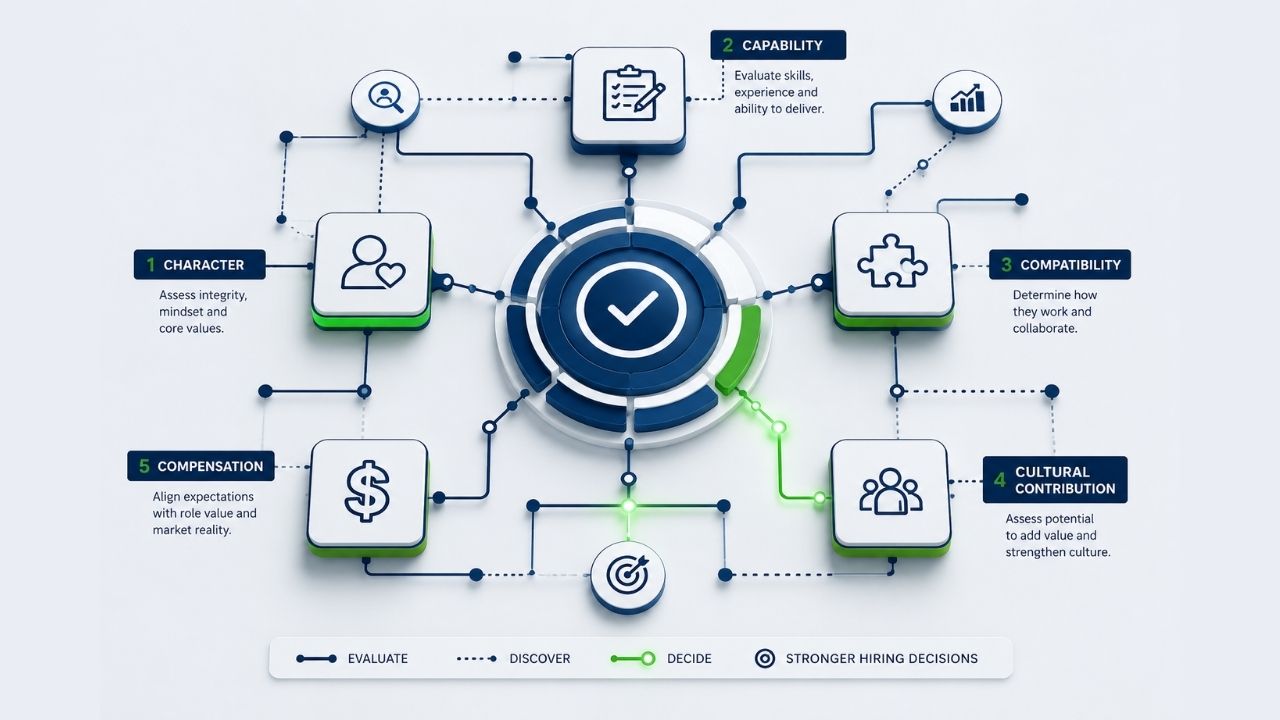
The 5 C’s of hiring are Character, Capability, Compatibility, Cultural Contribution, and Compensation. Together, these categories provide a balanced framework for evaluating candidates beyond resumes, job titles, and technical qualifications.
Many hiring decisions fail because organizations focus too heavily on one area. A candidate may possess impressive technical skills but struggle with collaboration. Another may communicate exceptionally well but lack the experience required for the role. The 5 C’s create a more complete picture by evaluating multiple dimensions of candidate success.
Rather than relying on gut feelings or isolated impressions, hiring teams can use the framework to assess each candidate consistently. This creates stronger discussions, better comparisons, and more informed hiring decisions.
Organizations often feel pressure to move quickly when a role remains open for an extended period. Unfortunately, urgency can sometimes replace discipline. A structured framework helps teams maintain consistency even when hiring pressure increases. As discussed in Hiring Readiness Is More Important Than Hiring Urgency, preparation often has a greater impact on hiring success than speed alone.
Evaluating the Complete Candidate Beyond the Resume
Resumes provide a useful starting point, but they only tell part of the story.
Most resumes highlight accomplishments, responsibilities, and career progression. They rarely reveal how someone approaches conflict, handles setbacks, collaborates with peers, or responds under pressure. Those qualities often determine whether a candidate ultimately succeeds.
A strategic hiring framework recognizes that strong hiring decisions require a deeper evaluation. Technical expertise matters. Relevant experience matters. However, long-term success often depends on factors that never appear on a resume.
This is why interview processes should focus on gathering evidence rather than confirming assumptions. Instead of simply validating what candidates claim to have accomplished, hiring teams should explore how those accomplishments were achieved. Understanding the process behind the result often provides more insight than the result itself.
Organizations that evaluate the complete candidate reduce the risk of making decisions based solely on credentials while increasing their ability to identify individuals who will thrive in the role.
Understanding Character, Capability, and Compatibility
Character is often the hardest quality to evaluate and one of the most important. It reflects integrity, accountability, professionalism, resilience, and work ethic. Technical skills can often be developed through training and experience. Character tends to reveal itself through behavior. Candidates who take ownership of mistakes, discuss challenges honestly, and demonstrate accountability often bring long-term value to organizations.
Capability focuses on whether someone can perform the responsibilities of the role. This includes technical expertise, industry knowledge, leadership skills, problem-solving ability, and relevant experience. Strong interview processes evaluate capability through examples and evidence rather than assumptions. Hiring teams should understand not only what candidates know today but also how they learn and adapt.
Compatibility evaluates how effectively a candidate can operate within the organization’s environment. Every business has unique communication styles, decision-making processes, leadership expectations, and team dynamics. Compatibility is not about hiring people who think alike. It is about understanding whether a candidate can work effectively within the structure and expectations of the organization.
When evaluated together, these three factors provide a strong foundation for hiring decisions.
Why Cultural Contribution Outperforms Culture Fit
For years, organizations talked about culture fit as a primary hiring objective. While the concept was well-intentioned, it often created unintended consequences.
Culture fit can sometimes encourage organizations to hire people who feel familiar. Individuals who share similar backgrounds, perspectives, experiences, or working styles may naturally appear to fit the culture. Over time, however, this approach can limit diversity of thought and reduce innovation.
Cultural contribution offers a stronger alternative.
Instead of asking whether a candidate fits the culture, organizations ask what the candidate adds to it. What experiences do they bring? What perspectives can strengthen the team? How might they challenge assumptions in productive ways?
Strong cultures are not built by hiring identical people. They are built by hiring individuals who share core values while contributing new ideas, experiences, and approaches. Organizations that embrace cultural contribution often develop more adaptable teams and stronger long-term performance.
This shift reflects a broader change happening across the hiring landscape. Organizations are increasingly recognizing that recruiting is not simply about filling positions. It is about building stronger, more capable teams that can help the business grow. That philosophy sits at the center of Recruiting Reimagined. And Why Right Now It Has Never Mattered More.
Aligning Compensation Early in the Interview Process
Compensation remains one of the most common reasons hiring processes fail late in the game.
Many organizations avoid discussing compensation until the final stages of the interview process. By that point, both sides have invested significant time and energy. Discovering a major gap in expectations at the offer stage creates frustration for everyone involved.
Compensation conversations do not need to be uncomfortable. In fact, addressing expectations early often improves the candidate experience. Candidates gain clarity about whether the opportunity aligns with their goals, while employers reduce the likelihood of losing qualified individuals late in the process.
Compensation should be viewed as part of the broader evaluation framework rather than a separate conversation. Understanding expectations early helps organizations make realistic decisions, improve offer acceptance rates, and create a smoother hiring experience from start to finish.
Compensation alignment often requires an understanding of market realities, candidate expectations, and competitive positioning. Organizations evaluating whether outside recruiting support makes sense for their business may benefit from Is It Worth Using a Recruitment Agency? The True ROI for Employers, which explores the operational and financial impact of recruiting partnerships.
Download the Interview Scorecard and Evaluation Matrix (Excel)
A strong hiring framework becomes even more effective when supported by consistent documentation. The Interview Scorecard and Evaluation Matrix provides hiring teams with a practical way to evaluate candidates against the 5 C’s framework while creating consistency across interviewers.
Using a structured scorecard helps reduce subjective decision-making, improves collaboration among hiring teams, and creates a clear record of candidate evaluations. Instead of relying on memory or general impressions, interviewers can document specific observations and compare candidates more objectively.

Related Articles
The Hidden Cost of a Bad Hire Beyond Salary
How Do You Improve Your Offer Acceptance Rates?
Hiring Readiness Is More Important Than Hiring Urgency
Recruiting Reimagined. And Why Right Now It Has Never Mattered More.
Is It Worth Using a Recruitment Agency? The True ROI for Employers